
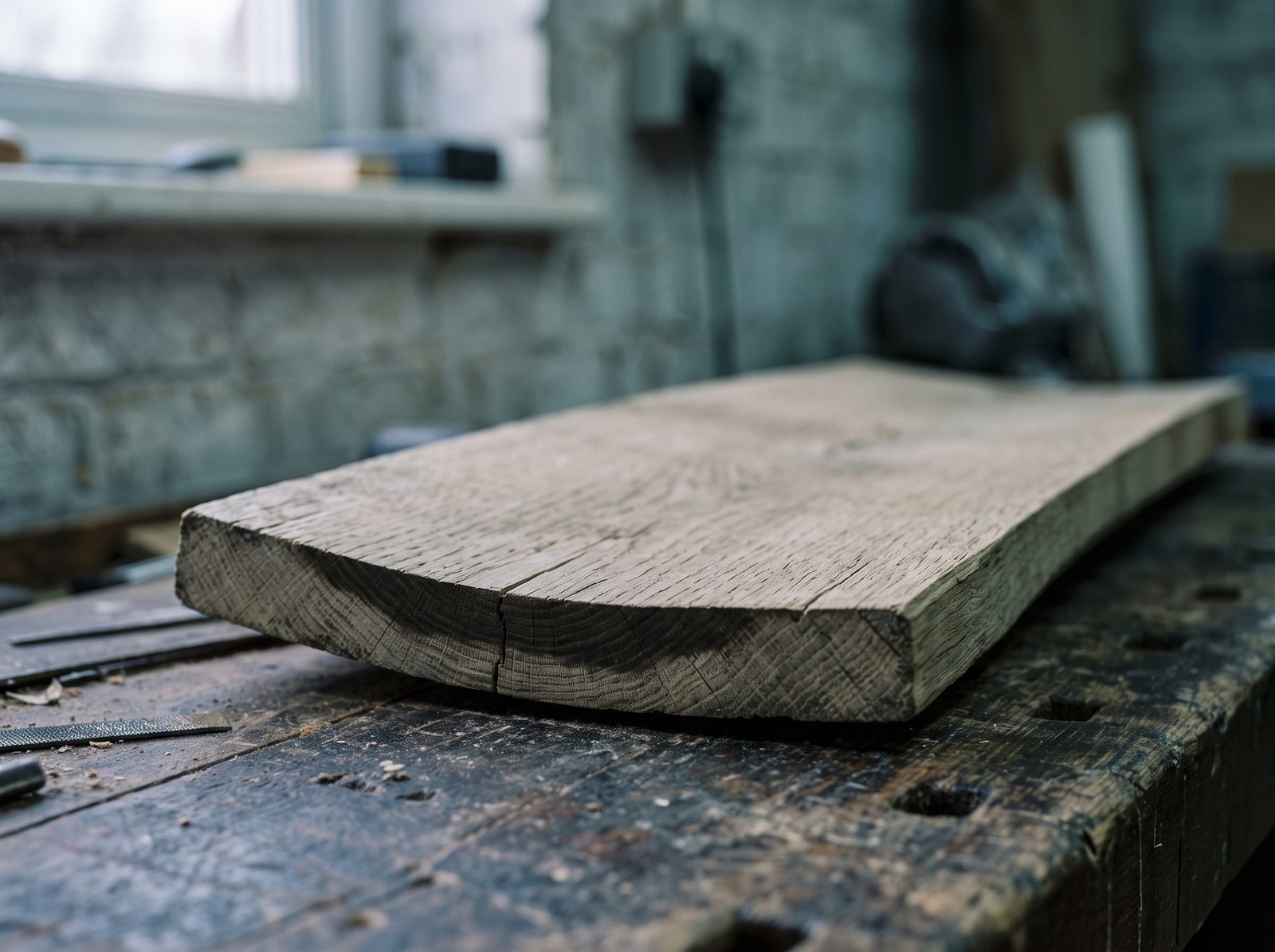
The answer is movement. And movement isn’t a fault — it’s the material behaving exactly as it must.
What movement actually is
Wood movement is dimensional change — shrinking or swelling — when moisture content changes below the fibre saturation point.
You’ll remember the distinction from Episode 1. Above FSP, water is mostly free water sitting in the hollow cells, and removing it doesn’t change the size of the wood. Below FSP, water is bound water held within the cell walls, and removing or adding it changes the physical thickness of those walls.
Bound water leaves, the wall gets thinner. Bound water enters, the wall swells. Multiply that across millions of cells and you get a board that has measurably changed size. Not damaged — changed. That’s normal material behaviour, and everything below follows from it.
Why it happens across the grain and not along it
Cell walls are built from cellulose microfibrils embedded in a matrix of hemicellulose and lignin. Water molecules bond to the hemicellulose and to the less-ordered parts of the cellulose, pushing between the chains.
The crucial detail: the wall expands perpendicular to the microfibrils, not along them. The microfibrils run roughly parallel to the length of the cell, so the swelling happens sideways — across the grain.
That one fact is why a board can change width noticeably while its length stays effectively fixed. It isn’t a quirk of certain species. It’s the architecture.
The three directions, and the ratio between them
Wood is anisotropic — it behaves differently depending on direction. Movement happens on three axes, and they are wildly different in size:
- Tangential — across the growth rings
- The largest movement. Typically 5–12% from green to oven-dry, depending on species. This is the direction that causes the damage you can see.
- Radial — along the growth rings, toward the centre
- Roughly half the tangential figure. Typically 2–6%.
- Longitudinal — along the grain
- Typically 0.1–0.3%. For practical purposes, wood doesn’t change length. There are exceptions in reaction and juvenile wood, but the rule holds.
The ratio is what you design against: tangential movement is roughly twice radial, and both are typically 20 to 100 times longitudinal. Those are rough figures that move by species — but the shape of the relationship is what matters, and it’s the root cause of cupping, warping and most joint failures.
Tangential exceeds radial in virtually every species you’ll meet. Rays run radially and act as internal restraint on radial movement; and tangentially, the dense latewood bands sit side by side with the lighter earlywood and drag it along with them, which pushes tangential movement up. The guides cover the detailing that lives with it.
Where the warp comes from
Once you see the three axes, the classic defects stop looking random.
Cupping — a flat-sawn board cups because the face nearer the bark is more tangential and shrinks more than the face nearer the pith, so the bark-side face goes concave and the board cups away from the heart. Bowing — a lengthwise curve, usually from juvenile or reaction wood, or growth stress released by sawing (both come up later in this track). Twisting — usually spiral grain, where the fibres don’t run straight, so shrinking lifts opposing corners in opposite directions. Checking and cracking — the surface dries faster than the core, tries to shrink, and the core resists until tension exceeds the wood’s strength.
Movement never stops
The common misconception is that once timber is dry it’s finished moving. It isn’t. Wood moves every time its moisture content changes, and that changes every time the humidity around it does.
In a centrally heated UK home the scale is bigger than people expect. A flat-sawn oak tabletop 500mm wide, swinging between about 8% and 12%, can move roughly 6mm across the seasons, and about half that quarter-sawn; a 200mm pine floorboard roughly 2mm.
Those aren’t small numbers on a fitted piece. They’re why traditional joinery uses floating panels, slotted fixings and expansion gaps — not because the maker was cautious, but because the wood leaves no alternative.
What drives the amount
Three things decide how much a given board will move:
- How much the moisture content changes — the one you have most influence over, and the one people overlook.
- The species — each has its own shrinkage coefficients.
- The direction — tangential, radial or longitudinal, per the ratio above.
The first is worth dwelling on, because it reframes the whole problem. It’s the change in moisture content that drives movement, not the absolute figure. A board sitting stable at 12% in an unheated shed isn’t moving, because nothing in its environment is changing. Take the same board into a heated home in winter, at around 8%, and it drops four points and shrinks accordingly.
There’s a formula for estimating the amount and the later guides cover the maths properly. The principle stands on its own: more change in moisture content means more movement. A big gap between where the timber is and where it’s going is the thing to catch before you build — which is why the acclimatising habit from the last guide matters.
You can’t stop it
Not with a finish, and not with care. A finish slows the rate of moisture exchange — genuinely useful, and why exterior joinery gets coated — but slowing isn’t stopping. You can reduce movement by choosing quarter-sawn boards, where the exposed face is radial and moves less; by choosing species with lower shrinkage coefficients; and by keeping the environment as stable as you can. The only way to all but eliminate directional movement is an engineered board, where cross-lamination or randomised fibre cancels most of it out.
For solid timber, the answer is never “prevent movement.” It’s design for movement — decide where it can go, and give it room. The classic failures are all that principle being ignored:
- Gluing a solid panel into a rigid frame. The panel can’t shrink, so it cracks, or it takes the frame with it.
- Screwing a tabletop straight to the aprons. The top can’t move across its width, so it cups or splits. Slotted fixings and buttons exist for exactly this.
- Assuming planed timber won’t move. Planing removes wood, not physics.
The rule worth keeping
Wood moves. It always has and it always will. The job isn’t to fight it — it’s to understand the direction, estimate the amount, and design around it.
Everything here leads to that one posture: stop trying to hold timber still, and start deciding how it will move. The later guides show you how to put a figure on it.
Next in the track
You know that wood moves, why, and where it moves most. What’s missing is the practical half: telling tangential from radial on a board you’re holding, and using that to choose and orient timber for a job. That’s Track 2, Episode 4: Tangential vs Radial Movement.