
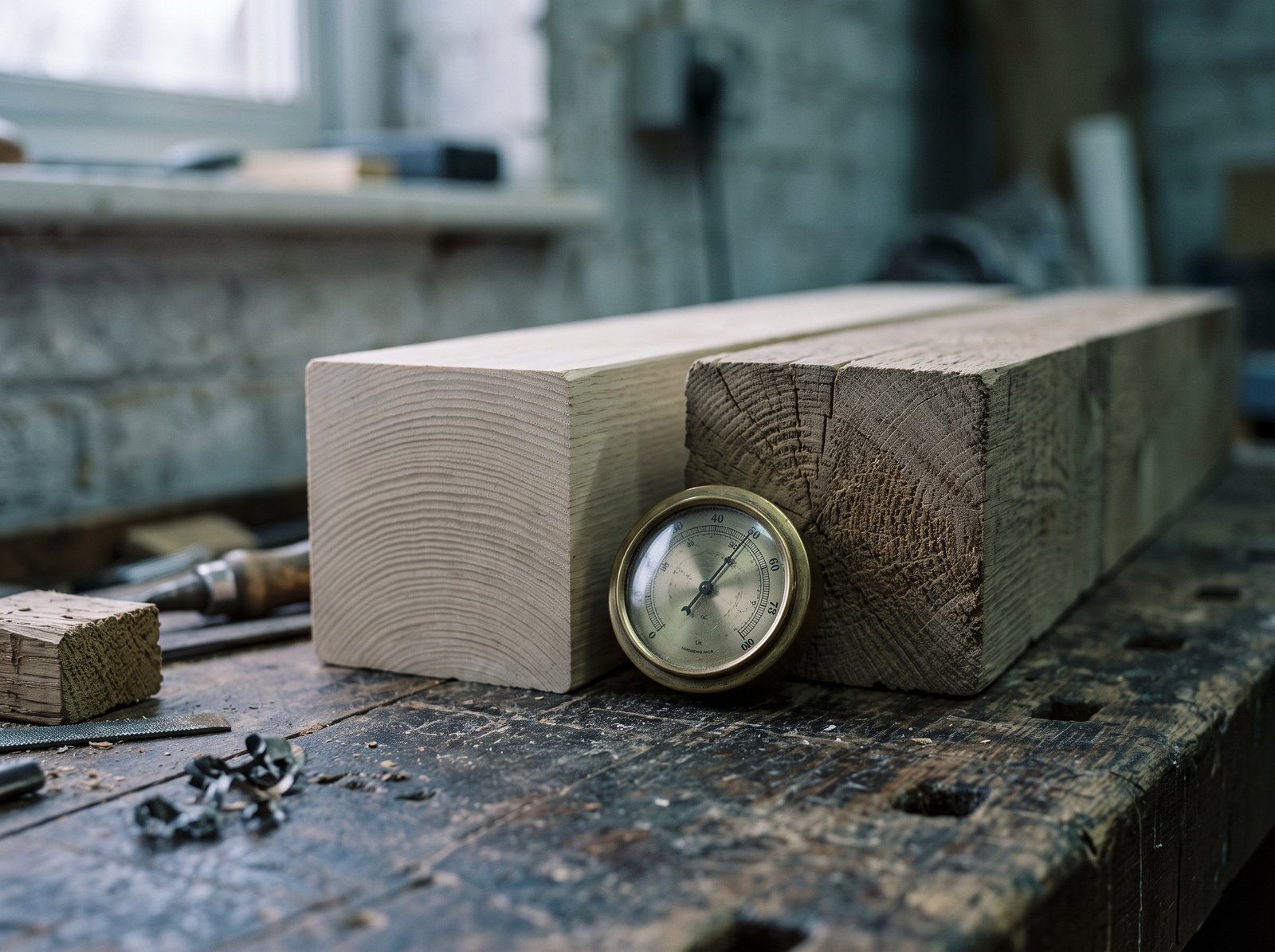
What equilibrium actually means
At EMC three things are true at once: the wood isn’t net-absorbing or net-releasing moisture, the vapour pressure inside the cell walls matches the vapour pressure in the air, and the wood is dimensionally stable for that moment.
That last phrase is doing the work. EMC isn’t a fixed property of the timber — it’s a function of the environment. Change the air and the timber starts moving toward a new balance point, and it will get there whether or not you’re ready for it.
Two things drive it, and one matters far more
EMC is governed by temperature and relative humidity. In practice, relative humidity does nearly all the driving.
- Relative humidity — the dominant factor
- Higher RH means higher EMC. Roughly: 30% RH settles wood near 6%, 50% near 9%, 65% near 12%, 80% near 16%. The curve steepens as it climbs.
- Temperature — real, but smaller
- At the same RH, warmer air produces a slightly lower EMC. It matters at the margins, not as the main lever.
So if you’re trying to work out where a piece will settle, read the humidity first. Temperature is the correction, not the answer.
EMC is a moving target
Because humidity swings with the seasons, EMC is never really fixed. In a typical UK home it walks up and down through the year.
- Winter, heating on, dry air — RH typically falls to around 40%, pulling EMC down to roughly 8%. Over underfloor heating, or in a room kept above about 21°C, it can drop to around 6%.
- Summer, heating off, more humid — RH rises to 50–65%, pushing EMC up to roughly 9–12%.
That swing explains a group of problems that get blamed on bad timber and rarely are: doors that stick in summer and show gaps in winter, floorboards that creak in the dry months, tabletops that crack through their first winter in a heated house.
The wood isn’t faulty. It’s following the equilibrium as the room changes around it.
Rough EMC by environment
Practical approximations for the UK, and enough to plan against:
- Heated home, winter
- RH around 40% → EMC roughly 8% (nearer 6% over underfloor heating or in a room kept above about 21°C)
- Heated home, summer
- RH 50–65% → EMC roughly 9–12%
- Unheated workshop or garage
- RH 55–75% → EMC roughly 10–14%
- Covered outdoor, shed or barn
- RH 65–85% → EMC roughly 12–18%
- Fully exposed outdoor
- RH 70–100% → EMC roughly 14–25% and up
These are approximations, and they shift by species and by the specifics of the building. But the takeaway is solid: the right moisture content for your timber depends entirely on where the finished piece will live. Not on what the yard had it dried to, and not on what it reads the day you collect it.
Why this matters more than “kiln dried”
Plenty of makers buy kiln-dried timber and assume the moisture question is closed. It isn’t — and this is the part of the label that doesn’t get explained at the counter.
Kiln drying takes timber down to a target, typically somewhere in the 8–12% region depending on the supplier and what they’re drying for. But the moment the timber leaves the kiln it starts exchanging moisture with wherever it’s kept.
- Kiln-dried timber sitting in a damp, unheated warehouse will take on moisture and climb back above its kiln-dried figure.
- Kiln-dried timber brought into a heated workshop in January may lose more and shrink further.
The label tells you where the timber was. EMC tells you where it’s going. Sound timber can be honestly described as kiln dried and still be wrong for your job — and the only way to catch that is to measure it.
Acclimatising: EMC in practice
Acclimatising means letting timber reach equilibrium with where it’ll live, so most of its movement happens before you build rather than after.
- Get it into the destination environment early. The room the piece is for, if you can manage it — not the workshop.
- Stack and sticker it. Air needs to reach every face, including the one nearest the floor.
- Give it time. Days to weeks — thickness, species and how far it has to travel all matter. Thick hardwood can take a long time through its full section.
- Measure before milling, and again before final assembly. The second check is the one people skip.
- Aim for the midpoint of the seasonal range. Not an exact number.
That last point is worth dwelling on. If a piece is going into a centrally heated UK home where EMC runs from roughly 8% to 12% across the year, building at around 9–10% means the timber can move in both directions, roughly equally. Build at 8% and it can only swell. Build at 12% and it can only shrink. The midpoint isn’t a compromise — it’s the only position where movement is symmetrical.
A subtlety worth knowing
Wood that’s losing moisture to reach equilibrium settles slightly higher than wood that’s gaining moisture to reach the same point. That’s sorption hysteresis.
The difference is small — usually 1–2% — and you don’t need to calculate it. But it’s worth knowing for two reasons: it explains why two boards sitting in the same room can honestly read slightly differently, and it’s another argument for aiming at the middle of a range instead of chasing one exact figure.
What it explains when things go wrong
- Building at 14% for a home that sits near 8% in winter. That’s a six-point drop, and a lot of shrinkage to ask a joint to absorb. It’s one of the commonest causes of a piece cracking through its first winter.
- Storing timber in a garage and expecting it to hold kiln-dried figures. The garage settles nearer 12–14%, and so will the timber. It didn’t dry wrong; it found a new balance.
- Finishing one face of a board. The raw face responds faster than the finished one, so the board cups: towards the raw face while the room is drying out, away from it when the room damps down. Whatever you put on one side, do the other.
- Rushing acclimatisation. A thick board can take weeks to reach equilibrium through its full thickness, even after the surface reads right.
The rule worth keeping
Build your timber to the moisture content it will live at, not the moisture content it arrives at.
That means three things, and they’re all cheap: know the EMC of where the piece is going, measure what you’ve actually been given, and give it time to settle before you cut. Everything in this guide leads back to those. The guides cover storage and acclimatising in more detail.
Next in the track
You now know what moisture content is and where it settles. What’s still missing is the mechanism — what’s physically happening inside a board when that number changes, and why it ruins some pieces and not others. That’s Track 2, Episode 3: Why Wood Moves.