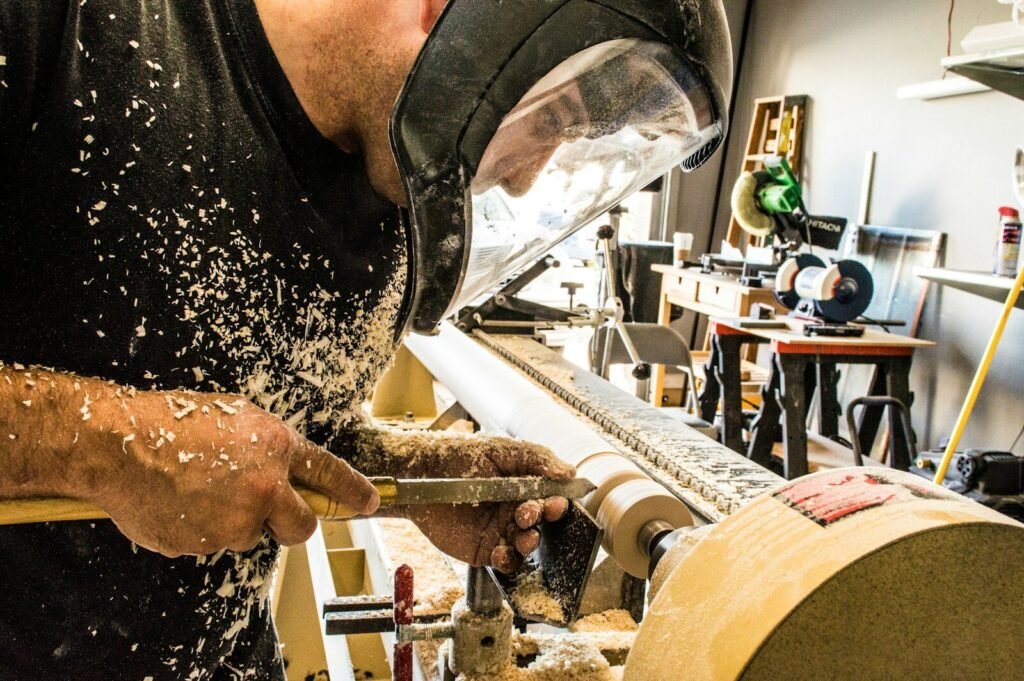
Turning and carving are the jobs where the wood’s moisture matters as much as the species. A wet log from a felled garden tree cuts easily with a knife or on the lathe, but a finished bowl made from it will move, crack or go oval as it dries. A dry blank stays put, but it’s harder work. Most of the decisions here come down to when you shape the wood relative to when it dries.
The other decision is what the piece is for. A spoon or salad bowl touches food, and the dust from making any of it is a health risk.
Green or seasoned
Green wood is freshly felled and full of water, and its easy cutting is why spoon carvers and many bowl turners prefer it. The catch is that wood shrinks as it dries, and unevenly: roughly twice as much around the growth rings as across them, and hardly at all along the grain. That difference is what splits logs and pulls round bowls oval.
Seasoned wood has done most of its shrinking, though it still moves a little as the air gets drier or damper through the year. Spindles, boxes and anything with a fitted lid or tight joint want dry stock, because a part that shrinks after you’ve sized it won’t fit any more.
Rough-turning green bowls
The usual way round the problem is to turn the bowl twice.
- Rough-turn it thick. A common rule is a wall about 10% of the diameter, so a 250mm bowl gets walls around 25mm. Even, thick walls give the wood room to distort without cracking.
- Keep the pith out. Cut blanks from either side of the log’s centre rather than through it, so no complete growth ring sits in the blank. The pith is where most splits start.
- Slow the drying. End grain loses water fastest. Seal it with a wax emulsion end-grain sealer, or wrap the rough bowl in newspaper or a paper bag. Sealing evens out the drying but adds weeks to it.
- Weigh it, then wait. Rough-turned bowls typically need a few months to air-dry. Weigh each one and write the figure on it: when the weight stops dropping, it’s ready to re-turn round and to its final thickness.
Some turners skip the second stage, turn green bowls thin in one go and let them warp as they dry, accepting the movement rather than controlling it.
Blanks or logs
Ready-cut, waxed blanks are the easy start: sized, usually checked for faults and often already part-dried. Logs and offcuts from tree surgeons, garden clearances and small sawmills give you more choice of figure, but you do the sorting, sealing and drying, and some will split. If you’re buying from a yard, ask whether the stock is green, air-dried or kiln-dried, whether the ends are sealed, and whether the blank includes the pith.
Woods that turn and carve well
For carving, softer and more even-grained woods are easier, especially when you’re learning.
| Timber | What to know |
|---|---|
| Sycamore | Pale, close-grained and plain, and a long-standing choice for spoons and kitchen bowls. A good all-rounder on the lathe and with a knife. See the sycamore page. |
| Ash | Strong, open-grained and bold in figure. A popular bowl and platter wood. HSE’s toxic woods sheet lists reduced lung function for ash dust, so extraction matters. The ash page has more. |
| Cherry and fruitwoods | Warm colour and fine texture, good for both turning and spoons. Wild cherry, pear, apple and plum often come from garden trees, so supply is in small, irregular pieces. |
| Birch | A classic spoon wood. Only a little harder than the soft woods when green, but very solid once dry, which makes for a durable spoon. See silver birch. |
Others worth knowing:
- Beech turns well and is a long-standing wood for tool handles.
- Walnut and oak are both good turning woods.
- Yew gives striking contrast between pale sapwood and orange heartwood, and is valued for turnery. See the yew warning below.
- Lime is the carver’s wood. It’s pale, fine-textured and even, resists splitting and holds very fine detail, which is why it’s the traditional choice for relief and decorative carving. Willow, alder and poplar are other soft woods that carve easily green.
Food-safe use and finishes
For spoons, spatulas and bowls that hold food, choose a close-grained wood without strong taste or smell (sycamore, birch, beech, cherry and other fruitwoods are the usual picks). Many spoon carvers leave the wood bare or oiled.
Don’t assume a finish is food safe just because it has dried. Check the maker’s data for food contact, and follow their curing time, because dry to the touch is not the same as fully cured. Food-grade mineral oil is simple and easy to renew but never hardens. Boiled linseed oil can contain drying additives, so it isn’t the same as raw linseed for this use. Walnut oil sold as a wood finish isn’t the same as the cooking oil, and if anyone in the household has a nut allergy, check before using it.
Dust and toxic woods
Wood dust is a health hazard. HSE states that hardwood dust can cause cancer, particularly of the nose, and is listed as carcinogenic under COSHH; both hardwood and softwood dust can cause asthma. The workplace exposure limit is 3mg/m³ for hardwood dust and 5mg/m³ for softwood dust (8-hour average). Those limits are written for employers, but the dust is the same in a garden workshop, and sanding on the lathe throws a lot of it into the air.
- Use extraction at the source, close to where the dust is made.
- Wear a properly fitted respirator rated for fine dust when sanding. A tight-fitting mask needs a clean-shaven face to seal.
- Don’t sweep up or blow dust off with an air line. Use a vacuum (HSE recommends at least Class M for workplaces).
Yew needs extra care. HSE’s toxic woods sheet lists yew for dermatitis, headache, a drop in blood pressure and cardiac effects. Almost every part of the tree contains taxine, a poison. Control the dust carefully, wear gloves if your skin reacts, and as a precaution keep yew for decorative pieces rather than things that hold food. HSE’s sheet also lists effects for beech, oak, walnut and birch dust, so don’t assume a familiar wood is harmless.
Home-grown timber and sawmills
Turners and carvers can use pieces too small or awkward for other makers. Independent sawmills that cut British hardwood may have short ends and odd pieces that are no use for joinery but fine for bowls. Ask for the species, when it was felled, and whether the ends have been sealed. If you collect fresh logs, seal the ends as soon as you get them home and convert them to blanks soon after.
Sources
- HSE, Wood dust: what you need to know (hardwood dust can cause nasal cancer, asthma, WELs of 3mg/m³ hardwood and 5mg/m³ softwood, extraction, face-fit RPE and clean shaven, no sweeping or air lines, Class M vacuum)
- HSE, Toxic woods (WIS30) (hardwood dust carcinogenic under COSHH Schedule 1; health effects listed for yew, beech, oak, ash, walnut and birch; its 5mg/m³ hardwood limit is out of date)
- Penn State Extension, Toxicity of yew wood and roots (yew among the most poisonous woody plants; taxine in all parts except the berry flesh)
- Woodworker’s Journal, Options for drying green bowl blanks (10% wall rule, no complete growth ring, tangential vs radial shrinkage, paper bags, wax sealer slows drying, weighing, about three months to air-dry)
- Robin Wood, What wood for spoon carving (lime, willow, alder, poplar for beginners; birch, sycamore and fruitwoods; birch hard when dry; carve green)
- Forestry and Land Scotland, Small-leaved lime (lime fine-textured and resistant to splitting, used for turning and carving)
- V&A, Grinling Gibbons’ lime wood cravat (lime’s uniform structure and fine detail in carving)
- Woodsmith, Facts about food-safe finishes (check maker’s data, dry vs cured, mineral oil doesn’t harden, boiled linseed additives, finishing walnut oil differs from cooking oil)