
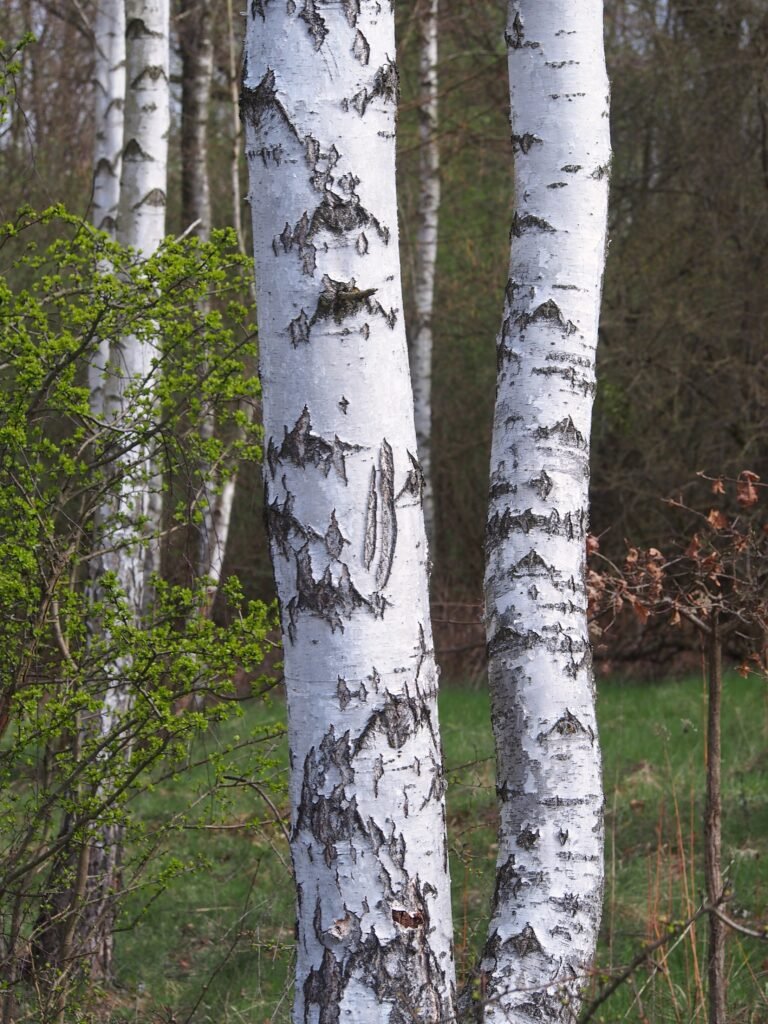
Handling & safety. No significant health reactions reported beyond standard wood dust risks.
Properties
| Latin name | Betula pendula |
|---|---|
| Species type | Hardwood |
| Origin | Europe, British Isles, Scandinavia to Spain. Native throughout the UK |
| Density | 670 kg/m³ |
| Janka hardness | 4,000 N |
| Modulus of rupture | 114 MPa |
| Elastic modulus | 13.3 GPa |
| Crushing strength | 53 MPa |
| Specific gravity | 0.67 |
| Porosity | Diffuse-porous |
| Movement class | Very low |
| Tangential shrinkage | 7.5% |
| Radial shrinkage | 5.5% |
| Volumetric shrinkage | 14.2% |
| T/R ratio | 1.4 |
| Durability (EN 350) | Class 5 |
| Relative cost | Budget |
Density and mechanical properties are typical values at around 12% moisture content. Shrinkage figures represent total dimensional change from fibre saturation to oven dry. Individual boards vary.
Description
Birch machines and turns well and is a cornerstone species for high-quality plywood, which is why “birch ply” has such a reputation for strength and stability. As solid timber, it’s generally cooperative but can feel slightly woolly if tools are dull, and its pale surface shows marks and glue smears easily.
Natural durability is low, so birch belongs indoors and needs prompt drying after conversion to avoid fungal staining. Used within those limits, it’s a versatile, high-value hardwood that bridges the gap between fine furniture material and industrial panel work.
Anatomy
- Porosity: Diffuse-Porous
- Vessel Arrangement: Diffuse-porous; vessels small to medium, solitary and in short radial multiples, often in a diagonal or波浪状 (wavy) pattern. Tyloses absent.
- Vessel Description: Diffuse-porous; vessels small to medium, solitary and in short radial multiples of 2–4, often in a diagonal or波浪状 pattern. Perforation plates simple. Tyloses absent.
- Parenchyma: Apotracheal parenchyma diffuse; paratracheal parenchyma very sparse. Strands of 2–4 cells.
- Rays: Rays uniseriate and biseriate; rays very narrow, typically 1–2 cells wide; ray cells procumbent with some square cells. Relatively numerous and close together.
Durability
- Durability Class: Class 5 — Perishable
Perishable (Class 5). Will readily rot and decay if exposed to the elements. Susceptible to insect attack. Must be dried quickly after conversion to avoid fungal discolouration.
Odor
No characteristic odor.
Uses & Availability
Common Uses
Plywood (especially Baltic/Finnish birch ply), furniture, flooring, turnery, brush backs, toys, dowels, and veneer (masur birch veneer is highly prized). Twigs used for besom brooms and horse jumps.
Pricing & Availability
Available in the UK from domestic and Scandinavian sources. Moderately priced. Finnish and Baltic birch plywood is very widely available and used throughout the UK.
Conservation
- CITES Status: Unlisted
- IUCN Status: Least Concern
Lookalikes & Substitutes
Downy birch (Betula pubescens) is very similar but grows on wetter soils. Paper birch and yellow birch are the North American equivalents.
Working the timber
Good — works fairly easily but can be inclined to be woolly. Planes and moulds to a good clean surface. Glues, stains, and polishes satisfactorily. An excellent turnery wood.
Finishing & gluing
Birch’s fine, diffuse-porous texture can look beautifully clean under clear coats, but it’s also prone to blotching and patchy stain uptake—use a washcoat/pre-conditioner or move to dye/toner colouring rather than pigment-heavy stains. On pale timber, sanding scratches and glue smears show fast, so keep prep consistent and remove squeeze-out early. Figured birch (curly/masur) benefits from scraping before finishing to keep the chatoyance sharp rather than ‘woolly’.
Birch glues reliably with standard PVAs and UF, but because it’s pale and unforgiving, keep glue spread controlled and clean squeeze-out immediately to avoid light patches under finish. If you’ve burnished the surface with very fine sanding, a quick scuff just before glue-up improves wetting. For bent laminations or high-stress joints, UF or epoxy reduces creep compared with basic PVA.