
Handling & safety. Although severe reactions are uncommon, oak has been reported as a sensitizer. Usually most common reactions include eye and skin irritation, as well as asthma-like symptoms.
Suitable uses
Beams and structural sections, feather-edge and cladding, joinery, flooring, stair parts, furniture, doors, gates and external frames.
Browse projectsProperties
| Latin name | Quercus robur |
|---|---|
| Species type | Hardwood |
| Origin | Europe, including British-grown stock. |
| Density | 675 kg/m³ |
| Janka hardness | 4,980 N |
| Modulus of rupture | 97.1 MPa |
| Elastic modulus | 10.6 GPa |
| Crushing strength | 46.3 MPa |
| Specific gravity | 0.67 |
| Porosity | Ring-porous |
| Movement class | Very low |
| Tangential shrinkage | 8.4% |
| Radial shrinkage | 4.7% |
| Volumetric shrinkage | 13% |
| T/R ratio | 1.8 |
| Durability (EN 350) | Class 2 |
| Relative cost | Budget |
Density and mechanical properties are typical values at around 12% moisture content. Shrinkage figures represent total dimensional change from fibre saturation to oven dry. Individual boards vary.
Oak, European — the benchmark hardwood
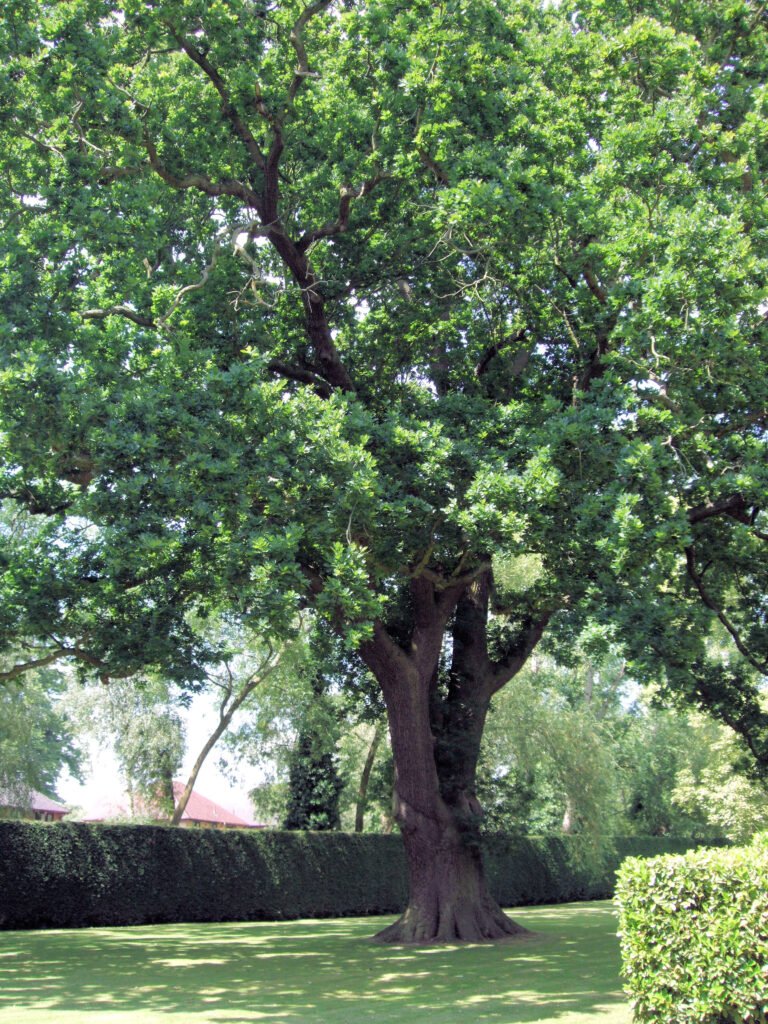
Oak is the timber most people picture when they think of British hardwood, and it earns that place on merit rather than romance. It’s strong, durable enough to leave outside untreated, and it works well with hand and machine tools — which between them cover most of what anyone actually needs a timber to do.
There’s a distinction worth getting straight early, because it causes more confusion than any other thing about oak. English oak and European oak are the same wood. English oak is Quercus robur — pedunculate oak, the oak of the British hedgerow. European oak covers that species plus sessile oak (Quercus petraea) and the oaks of mainland Europe, which are so close in character that the trade treats them together. When you buy “oak” in Britain you’ll get white oak from one or the other, and the differences are subtle: English oak tends to be slightly denser and more figured, European oak from managed forests often straighter and more consistent board to board.
What it’s like to work
Oak is a pleasure on most tools, but it asks one thing of you above all others: be careful with anything iron. Oak reacts with ferrous metal, especially when wet, and leaves blue-black staining that soaks in and won’t plane out. That means no steel cramps left on wet oak, and no iron fixings in exterior work — stainless or hot-dipped galvanised only.
Its density means it isn’t the fastest timber to saw or machine, and the grain — especially in figured boards — can tear out if you push too fast in the wrong direction. Take lighter passes. In return you get a timber that planes to a superb finish, steam-bends unusually well for its density, and takes oil, wax and stain beautifully.
Drying and movement
Oak is a medium-movement timber — it shrinks noticeably as it dries from green, and it will move in service if it isn’t properly dried and acclimatised. Green oak frames are designed on the assumption that the timber will move a great deal as it dries — that’s the tradition, and it’s fine when the design allows for it. Kiln-dried oak for joinery and furniture wants to sit in the place it’ll live for a few weeks before you cut it. Expect some checking on exposed end grain; that’s normal, not a defect.
Where it earns its place
Beams and structural sections, because oak takes load and doesn’t rot. Feather-edge cladding, because it weathers to a silver-grey that suits the British landscape. Joinery, doors, gates, external frames, flooring, stair parts and furniture — the sort of work where the timber is meant to outlive the person who made it.
Where it costs you
Oak is priced as what it is — one of the best general-purpose hardwoods there is — and good widths and long lengths are the expensive part. It’s heavier to handle than most, it demands stainless or galvanised fixings in external work, and it will move on you if you rush the acclimatisation. None of that is a problem, but all of it is worth knowing before you start rather than after.
Buying note. Ask for the grade and the moisture content, and ask whether it’s English or European if that matters to you. For exterior work, ask about heartwood content — sapwood doesn’t have the durability and shouldn’t be relied on outside. For anything visible, ask to see the actual boards or a representative sample: oak varies hugely in figure and colour between trees.
Working the timber
The Wood Database rates English oak (Quercus robur) as having very good resistance to decay, and records high shrinkage. Strength figures beyond density, specific gravity and Janka are not stored here because they were not in the checked table. EN 350 class 2 matches the library’s mapping for that durability, the same class used for American white oak.
Finishing & gluing
English oak is tannin-rich and ring-porous, so iron contamination can turn finishes blue-black—keep steel wool, ferrous dust and ordinary nails away from wet oak surfaces. Clear finishes highlight ray fleck beautifully, but the open pores usually need filling if you want a flat, furniture-grade sheen. If you’re fuming, staining or ebonising, test on offcuts: oak’s tannin level can make colour reactions much stronger than expected.
Oak bonds well with PVAs and UF, but tannins and acidic extractives mean clean, fresh surfaces help—plane/sand immediately before glue-up. Avoid iron clamps directly on the wood, especially if moisture is involved, to prevent black staining along glue lines. For exterior joints, use a durable adhesive (resorcinol, epoxy, PU or D4 PVA) and detail the joint to shed water; oak will last, but glue lines fail when they stay wet.