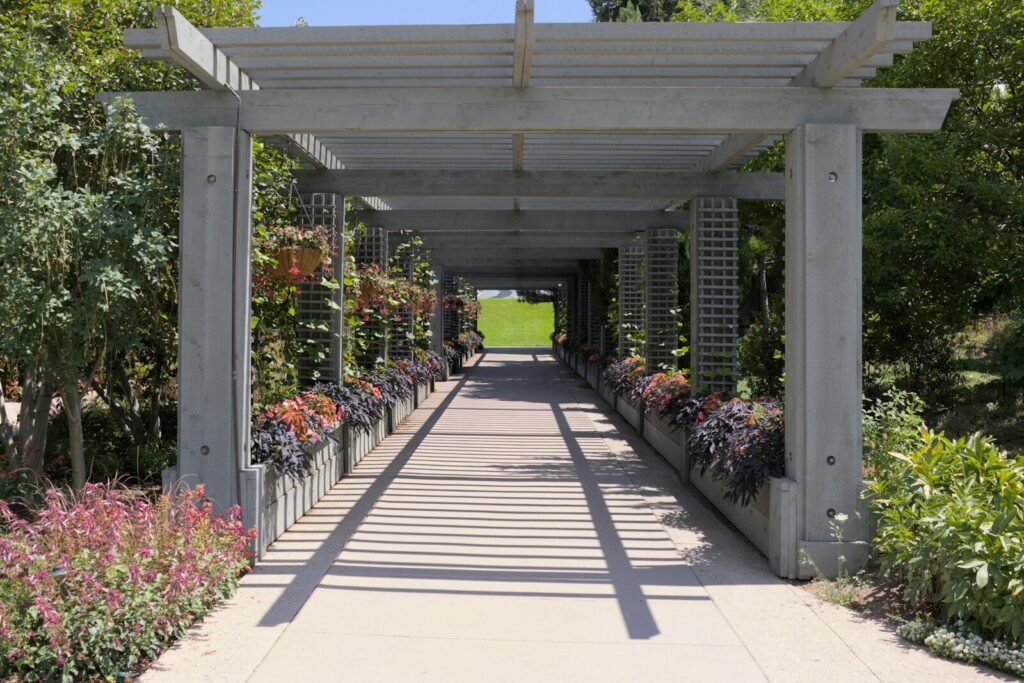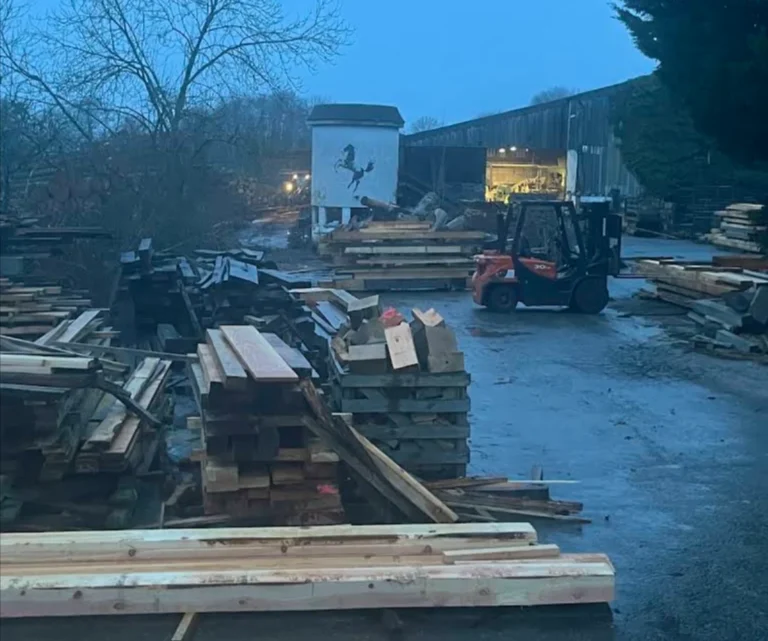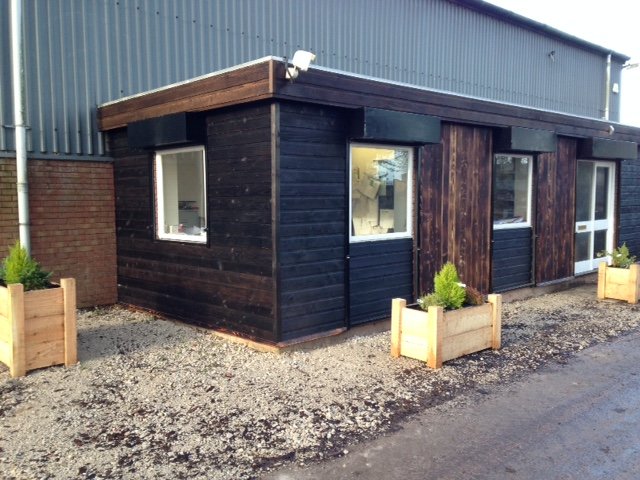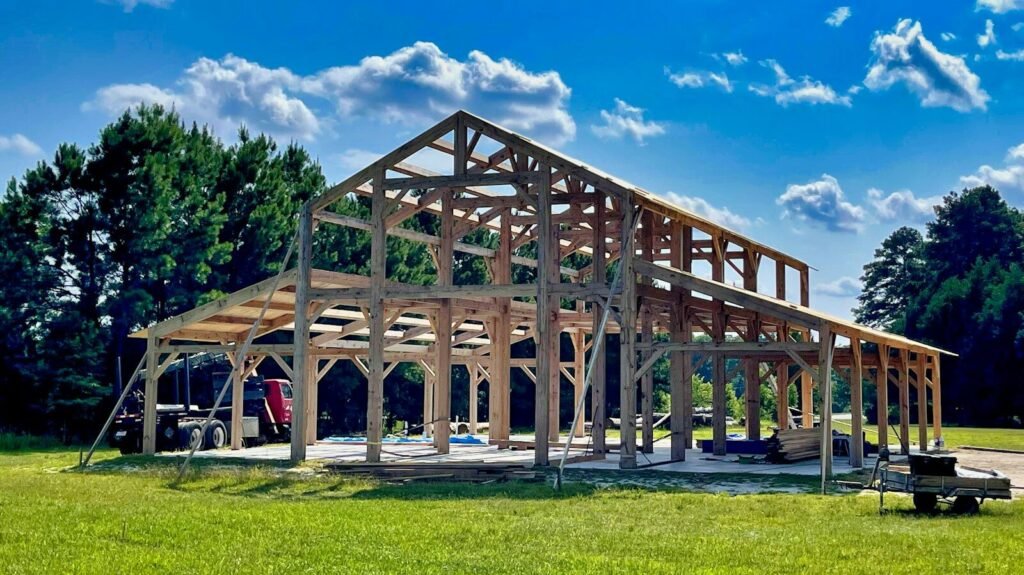
A green oak porch, carport or pergola is built from oak that’s still wet, and it’s meant to be. The decision that matters isn’t really oak or not oak. It’s accepting that the frame will shrink, split and bleed tannin as it dries, and making sure the joints, fixings and feet are designed for that from the start.
Green, air-dried or kiln-dried oak?
Oak for framing is almost always used green, straight from the sawmill, at a moisture content that can be as high as 80%. TRADA gives the reasons: seasoned oak is harder to work, dries very slowly and fissures easily, and seasoned stock is generally limited to about 100mm thick. The rule of thumb is a year of air-drying per inch (25mm) of thickness, so TRADA puts a 150 x 150mm post at six years or more. Air-dried oak is useful for pegs and smaller members; kiln-dried oak is for joinery and furniture. For frame sections, green is the only practical option.
Timber choices for small frames
| Timber | What to know |
|---|---|
| Green oak | The traditional choice and the one most framers work in. The heartwood is rated durable, so it can be left untreated outdoors as long as the sapwood is kept out of exposed members. It shrinks and fissures a lot as it dries, and it bleeds tannin for months, so the design has to allow for both. |
| Douglas fir | One of the two softwoods most readily available in larger framing sizes. Imported heartwood is rated moderately durable and can be used untreated with the sapwood excluded. Check durability and any treatment with the framer for exposed members. |
| Larch | The other softwood readily found in big sections, and often UK-grown. Moderately durable in the heartwood, and an option for a pergola or carport where oak isn’t wanted. Quality and sapwood content vary, so ask what grade you’re getting. |
The European oak, Douglas fir and larch pages cover supply and durability in more detail. TRADA also mentions sweet chestnut as an alternative to oak, though it’s less stable in large sections.
Shrinkage and checking
Green oak shrinks across the grain as it dries: TRADA gives about 4.5% radially and 7% tangentially from green to 10% moisture content, and almost nothing along the length. That uneven shrinkage is what opens up the fissures (checks) you see on every oak frame. TRADA’s guidance treats them as a characteristic of the material rather than a defect, and notes they’re almost never deeper than half the section. They narrow a little when wet but never close completely.
Anything fixed to the frame, such as glazing, roofing or a door lining, has to cope with the frame moving around it.
Joints designed for movement
Traditional green oak frames use pegged mortise and tenon joints, and the pegs do more than hold the joint together. In draw-boring, the peg hole through the tenon is drilled slightly offset from the hole through the mortise (TRADA’s figure is typically 3mm), so driving the peg pulls the shoulder of the joint tight. The pegs are seasoned oak, so they don’t shrink as the frame does, and they lock the joint as the green timber dries.
Pegged joints take little tension, which is why braces usually go in opposing pairs. Some framers add discreet stainless bolts or plates at heavily loaded joints.
Grading and sizing
Structural hardwood in the UK is visually graded to BS 5756. Large sections are graded THA or THB (heavy structural) and smaller sections TH1 or TH2 (general structural); in each pair the first is the higher grade. Graded oak runs from strength class D24 for TH2, the lowest grade, up to D40 for THA, so the grade matters as much as the species. Ask the yard or framer whether the timber is graded, and to which grade.
Don’t take post and beam sizes from a forum or someone else’s porch. Green oak is weaker than dry oak, and a porch or carport roof may meet its first snow or high wind while the timber is still green. TRADA’s guidance is that a construction professional, such as an engineer or a framer working with one, should take responsibility for the design. LABC Warranty’s guidance on porch and canopy posts says they must be designed by a structural engineer to withstand all relevant loads.
Practical notes
Tannin staining and fixings
- Use stainless steel for everything. Oak’s tannins corrode mild steel, and the iron reacts with them to leave blue-black stains.
- Plan for tannin run-off. Green oak outdoors bleeds dark tannin onto brick, paving and stone below, for many months. Protect those surfaces while it weathers.
Keep the feet off the ground
- Never bury posts. TRADA says permanent ground contact should be avoided, and exposed end grain soaks up water.
- Stand posts on stone pads, plinths or a raised base. LABC Warranty’s guidance is that porch posts should sit on a raised foundation support, with corrosion-resistant metal connectors where they meet brick or concrete and a clear air path under the post.
- Avoid water traps. Joints that face upwards or hold water get worse as the timber shrinks. Shape tops and bottoms to shed water.
Planning and building regulations
In England, the Planning Portal says a porch on any external door of a house is usually permitted development (no planning application) if the ground floor area is no more than 3 square metres, no part is more than 3 metres high, and no part is within 2 metres of a boundary facing a highway. That doesn’t apply to flats, some converted houses, or where permitted development rights have been removed. A ground-level porch under 30 square metres is normally exempt from building regulations, provided the front door between house and porch stays and any glazing and electrics comply.
A carport or pergola isn’t a porch, so other rules apply, such as the outbuilding limits on height near boundaries and on building forward of the front of the house. These rules are for England. In Wales, Scotland or Northern Ireland, and at a listed building or in a conservation area, check with your local planning authority.
Sources
- Yandles, Declarations of conformity for graded oak (strength classes by grade: THA D40, THB D30, TH2 D24)
- TRADA, Green Oak in Construction (2007) (why framing oak is used green, moisture content, shrinkage figures, fissures, seasoned pegs and 3mm draw-bore offset, opposing braces, D30 to D40, Douglas fir and larch in large sections, sweet chestnut, tannin bleeding and stainless fixings, avoiding ground contact, professional responsibility for design)
- BM TRADA, Back in the frame: green oak (designing for shrinkage, tannins corroding mild steel, stainless or non-ferrous fixings, protecting surfaces below)
- BSI, BS 5756 Visual strength grading of temperate hardwood (BS 5756:2007+A2:2017; THA and THB heavy structural grades for large sizes, TH1 and TH2 general structural grades for smaller sizes)
- GreenSpec, Timber cladding: selecting a species (EN 350 durability of oak, larch and imported Douglas fir; sapwood exclusion; green oak tannin leakage)
- LABC Warranty, Timber posts for canopies, porches and bay roofs (2022) (raised supports, air path under posts, no buried posts, corrosion-resistant fixings, structural engineer design)
- Planning Portal, Porches: planning permission (3 square metre, 3 metre and 2 metre permitted development limits and exclusions)
- Planning Portal, Porches: building regulations (30 square metre exemption and its conditions)
- Planning Portal, Outbuildings: planning permission (outbuilding limits that apply to frames that aren’t porches)