
Handling & safety. Pine dust has been reported to cause skin reactions and asthma-like symptoms in some people. Extract when machining.
Properties
| Latin name | Pinus palustris (longleaf; the usual Wood Database stand-in for the southern yellow pine group) |
|---|---|
| Species type | Softwood |
| Origin | Southeastern United States. Trade “southern yellow pine” also includes slash, shortleaf and loblolly. |
| Density | 650 kg/m³ |
| Janka hardness | 4,120 N |
| Modulus of rupture | 100 MPa |
| Elastic modulus | 13.7 GPa |
| Crushing strength | 58.4 MPa |
| Specific gravity | 0.65 |
| Porosity | Non-porous (softwood) |
| Movement class | Very low |
| Tangential shrinkage | 7.5% |
| Radial shrinkage | 5.1% |
| Volumetric shrinkage | 12.2% |
| T/R ratio | 1.5 |
| Durability (EN 350) | Class 3 |
| Relative cost | Budget |
Density and mechanical properties are typical values at around 12% moisture content. Shrinkage figures represent total dimensional change from fibre saturation to oven dry. Individual boards vary.
Southern Yellow Pine — the dense American structural pine
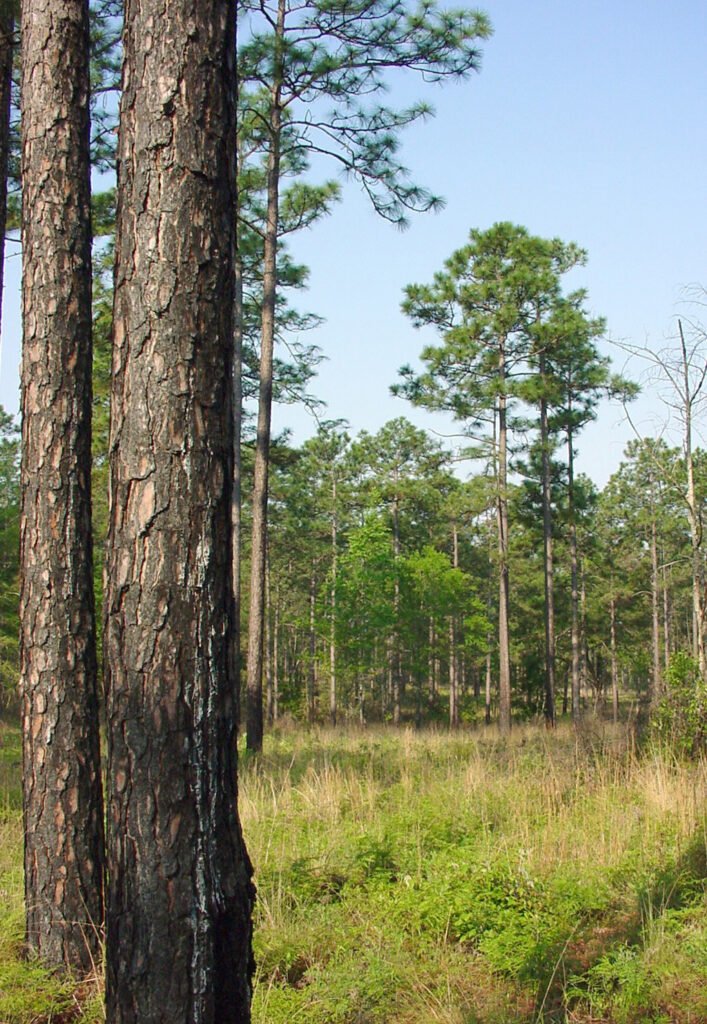
Southern Yellow Pine isn’t one species — it’s a trade group of several closely related American pines from the south-eastern United States, of which longleaf pine (Pinus palustris) is the most valued. They share characteristics that make them quite unlike the softwoods most British woodworkers are used to: they’re dense, hard, resinous and strong, with a strength-to-weight relationship that puts them close to some hardwoods.
If you’ve only worked with spruce or redwood, Southern Yellow Pine will surprise you. It feels like a different class of timber entirely — heavier, tougher, much harder to cut. That isn’t a defect, it’s the point of it.
What it’s like to work
Fairly well, but it asks for good tooling. It works with most hand and machine tools, though its density means you’ll take it steadily, and its resin is the main practical nuisance — it gums up blades and clogs sandpaper, worse than European pines. Keep blades clean, clear swarf, and expect to change paper more often than you’d like. It glues and finishes well, and it takes a screw or a bolt with real confidence because of its density.
One health point: pine sawdust is among those reported to cause skin reactions and asthma-like symptoms in some people. With a resinous timber like this, extraction and a mask are worth having.
Drying and movement
This is where it differs most from what you might expect. Southern Yellow Pine is dense and carries more internal stress than the European softwoods — it wants proper kiln drying and a period of acclimatisation before it’s cut for anything precise. Movement in service is moderate but more pronounced than in spruce or redwood. Acclimatise it like a hardwood: let it sit in the space it will live before final dimensioning.
Where it earns its place
Heavy structural work and floor joists, where its strength lets you use less timber than a European softwood would need. Industrial and workshop flooring, where its hardness stands up to wear. Decking substructures, treated. Stair parts and workshop benching. Anywhere you need softwood-price structural performance and don’t mind a timber that fights back a little.
Where it costs you
It’s imported, so it’s priced above home-grown softwoods — and you’re paying for strength and density you may not need if the job is ordinary framing. It’s harder to work than European pine, it blunts tools faster, and its resin is a nuisance in the workshop.
Buying note. Ask whether it’s treated and what for, particularly for external or ground-contact work. Ask about grade and moisture content for structural use — with imported structural timber, the grade is what tells you it’s fit for the load. If the finished surface will show, ask to see the boards: Southern Yellow Pine varies in colour and resin content between pieces.
Working the timber
Works fairly well. Resin gums tools and clogs sandpaper. Typical figures from The Wood Database for longleaf pine, the dense end of the southern yellow pine group. Heartwood is rated moderately resistant to decay; exterior stock is usually treated.
Finishing & gluing
Glues and finishes well once resin is not flooding the surface.
Glues well. Resin-rich faces want a fresh pass first.