
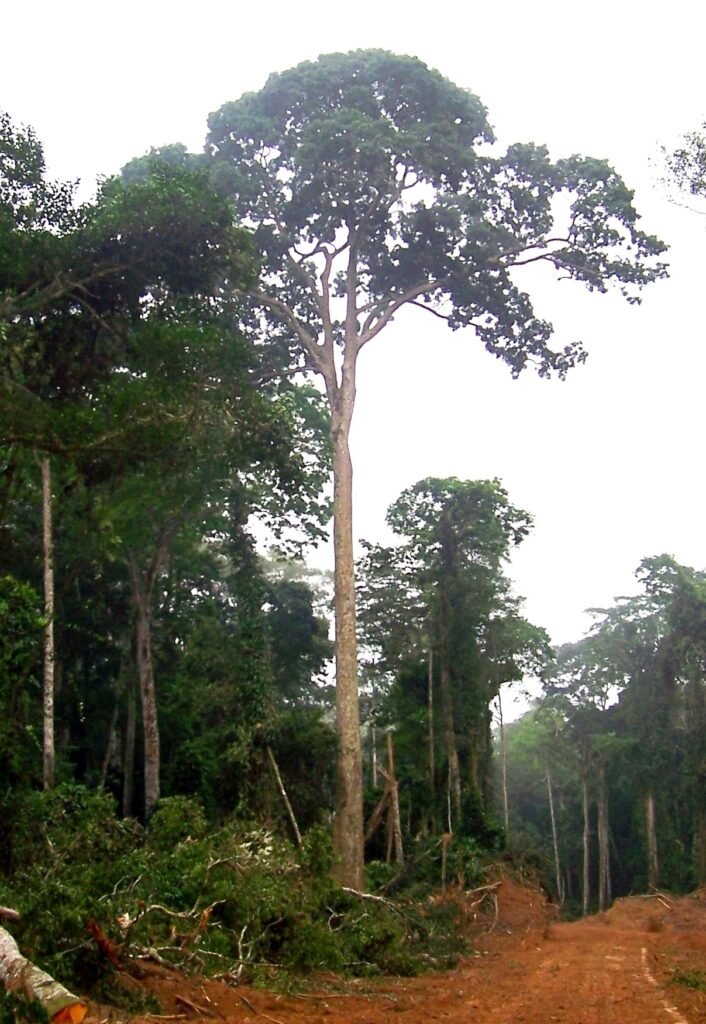
Handling & safety. Sapele dust is a skin and respiratory sensitiser for some people — gloves, extraction and a dust mask when machining are sensible.
Suitable uses
Interior joinery, furniture, window frames, doors, panelling, cabinets, stair parts.
Browse projectsProperties
| Latin name | Entandrophragma cylindricum |
|---|---|
| Species type | Hardwood |
| Origin | West and Central Africa — select logged, FSC and PEFC stock available. |
| Density | 665 kg/m³ |
| Janka hardness | 6,060 N |
| Modulus of rupture | 110.9 MPa |
| Elastic modulus | 12.35 GPa |
| Crushing strength | 58.9 MPa |
| Specific gravity | 0.67 |
| Porosity | Diffuse-porous |
| Movement class | Medium |
| Tangential shrinkage | 7.2% |
| Radial shrinkage | 5.2% |
| Volumetric shrinkage | 12.9% |
| T/R ratio | 1.4 |
| Durability (EN 350) | Class 3 |
| Relative cost | Mid |
Density and mechanical properties are typical values at around 12% moisture content. Shrinkage figures represent total dimensional change from fibre saturation to oven dry. Individual boards vary.
Sapele is the timber that quietly does an enormous amount of interior work. Look at a lot of fitted furniture, modern window frames and internal doors and you’re probably looking at sapele — even where it’s been sold as something else.
It’s a warm reddish-brown hardwood with a fine, even texture and a natural lustre that finishes beautifully. Colour varies from a golden red through to a deeper mahogany brown, and it darkens with exposure to light. Worth knowing if you’re matching to something that already exists.
The sensible answer to “I want mahogany”
This is where sapele earns its place. Genuine mahogany is expensive and increasingly hard to specify with confidence; sapele gets you a very similar look and working character at a price that makes whole-kitchen jobs realistic.
It’s the standard substitute. In most applications it’s not a compromise at all — it’s a straightforwardly good timber that happens to look like a dearer one.
What to watch: interlocked grain
Sapele typically has interlocked grain — the fibres alternate direction in bands up the trunk. That’s what produces the striped figure people like about it.
It’s also what makes it prone to tearout. You plane in one direction and get a clean cut, then the grain reverses a few centimetres further on and tears instead.
What fixes it: a sharp iron, a lighter cut, and attention to which way each section of the board is running. Don’t assume the whole board runs one way, because with interlocked grain it genuinely doesn’t.
Sapele and utile are not the same timber
The two get confused constantly, and they’re different materials.
- Sapele is usually denser and slightly darker, with finer texture and more obvious stripe.
- Utile tends to be lighter, softer and a little plainer.
If you’re matching to an existing piece, seeing the actual stock matters far more than the name on the label. Ask which you’re being offered — utile and sapele are regularly sold interchangeably, and they don’t match each other.
Keep it inside
Sapele is often described as moderately durable, and there is some natural resistance in it. But it isn’t a timber to rely on outdoors. Untreated in an exposed position it won’t hold up, and it’s not the material to specify if the job has to survive weather.
Working the timber
Interlocked grain makes sapele prone to tearout when planed — reduce the blade angle and take lighter cuts on figured stock. It machines, turns and moulds well otherwise, and quartersawn ribbon-stripe stock finishes beautifully.
Finishing & gluing
Takes polish, lacquer and oil very well — it is a cabinetmakers favourite for a reason. Ribbon figure deepens under oil-based finishes.
Glues reliably with standard adhesives; diffuse-porous structure takes adhesive evenly with no special preparation beyond clean surfaces.