
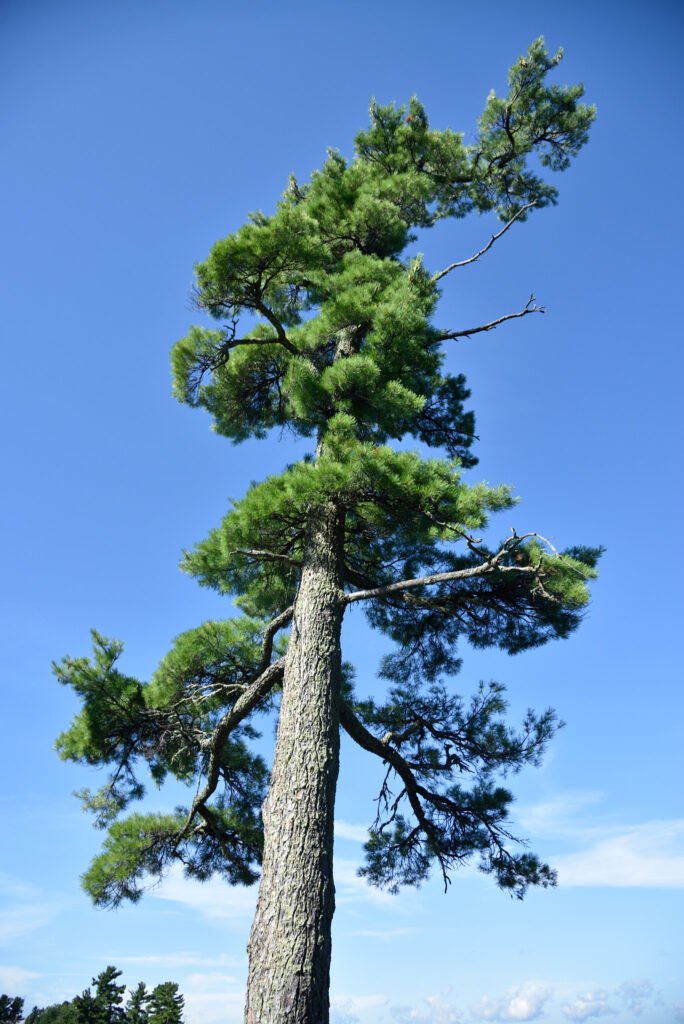
Handling & safety. Not commonly reported as a strong sensitizer; wood dust can irritate in some individuals.
Properties
| Latin name | Pinus strobus |
|---|---|
| Species type | Softwood |
| Origin | Eastern North America (Canada and the northeastern United States). |
| Density | 350 kg/m³ |
| Janka hardness | 1,700 N |
| Modulus of rupture | 59 MPa |
| Elastic modulus | 8.3 GPa |
| Crushing strength | 33 MPa |
| Specific gravity | -0.6 |
| Porosity | Non-porous (softwood) |
| Movement class | Very low |
| Tangential shrinkage | 6.1% |
| Radial shrinkage | 2.1% |
| Volumetric shrinkage | 8.2% |
| T/R ratio | 2.9 |
| Durability (EN 350) | Class 4 |
| Relative cost | Budget |
Density and mechanical properties are typical values at around 12% moisture content. Shrinkage figures represent total dimensional change from fibre saturation to oven dry. Individual boards vary.
Description
It is best suited to interior joinery, furniture, panelling, mouldings, shelving, boxes, carving, pattern making and painted work. Because it is soft and relatively low in density, it cuts and shapes easily but can dent or mark under heavy use. It is not naturally durable enough for exposed outdoor work unless properly treated, protected, or used in a sheltered application.
For makers, Eastern white pine is a practical, forgiving timber rather than a premium decorative one. It is a good choice where light weight, workability, availability and a clean painted or simple natural finish are more important than hardness or wear resistance. Its stability and ease of working make it especially useful for traditional interiors, rustic furniture, signs, craft projects and low-stress joinery.
Anatomy
- Porosity: Non-porous
- Vessel Arrangement: None — softwood, so no vessels or pores
- Vessel Description: Absent; Eastern white pine is a softwood and does not have hardwood-style vessels
- Parenchyma: Sparse / not prominent; softwood structure mainly tracheids with resin canals
- Rays: Fine, narrow rays; mostly not visually prominent
Durability
- Durability Class: Class 4 — Slightly Durable
Heartwood has moderate to low decay resistance; best performance when kept dry or well-coated/maintained.
Odor
No characteristic odor.
Uses & Availability
Common Uses
Interior trim, cabinetry, paneling, carving, doors/windows, general construction, boxes/crates.
Pricing & Availability
Widely available in its native range; generally affordable.
Conservation
- CITES Status: Unlisted
- IUCN Status: Least Concern
Lookalikes & Substitutes
Scots pine, Western white pine, sugar pine, radiata pine, ponderosa pine, spruce, poplar, tulipwood
Working the timber
Easy with hand and machine tools; glues and finishes well.
Finishing & gluing
Eastern white pine finishes easily, especially with paint, wax, oil, stain and simple clear interior coatings. Because it is soft and fairly absorbent, stains and dyes can sometimes go blotchy, so test pieces are important and a sanding sealer, pre-stain conditioner or washcoat can help even out the colour. It is especially good for painted furniture, panelling, mouldings, signs and traditional interior joinery. Clear finishes keep the pale, soft pine look, while oils and varnishes can warm the colour to a deeper honey tone. For exterior use, it needs treatment, good detailing and a suitable exterior coating system because it is not naturally durable.
Eastern white pine glues very well with standard woodworking adhesives, including PVA, aliphatic resin, polyurethane and epoxy. Its soft, even texture gives good bonding surfaces, but joints should be freshly prepared, clean and dust-free. Avoid excessive clamping pressure because the fibres can compress and weaken the glue line. For interior work, normal PVA is usually fine; for exterior or damp conditions, use an exterior-rated adhesive and remember that the timber itself still needs protection from moisture.