
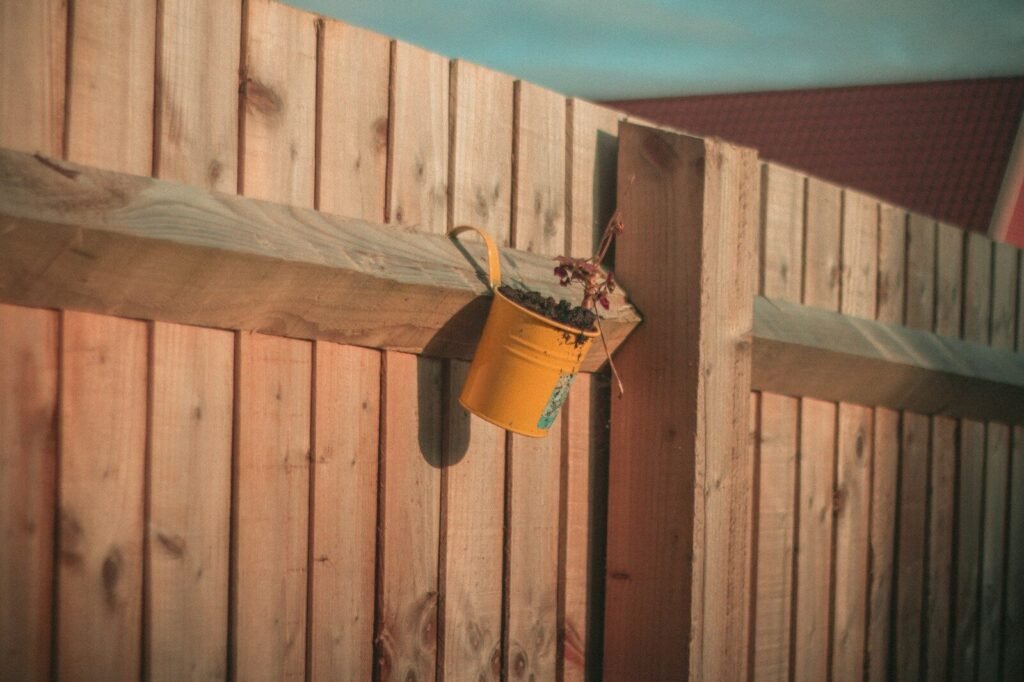
A fence or gate fails at the ground line long before it fails anywhere else. The boards can look fine while the posts rot just below the soil, until a big wind lays the run flat. So the decision that matters most isn’t the style of fence. It’s what the posts are made of, how they’re treated, and how they’re set.
The second is the gate, where staying square depends more on how it’s braced than on the timber.
Timber choices for fences and gates
Most garden fencing is pressure-treated softwood. Larch, oak and sweet chestnut are the natural alternatives.
| Timber | What to know |
|---|---|
| Treated softwood | The standard choice for posts, rails, boards and panels. What matters is the level of treatment, not the colour. Posts in the ground need Use Class 4 (ground contact); rails and boards above ground are Use Class 3. Treated timber looks the same either way, so ask the yard which use class it was treated to under BS 8417, and for posts, whether they are incised. |
| Larch | Often UK-grown. The heartwood is rated moderately durable but the sapwood isn’t, and larch posts usually carry some sapwood, so treat them as you would any softwood. The larch page covers the different larches. |
| Oak | Heartwood rated durable, and the traditional timber for gate posts, heavy gates and post and rail. The sapwood band is not durable and needs to be kept out of the ground or treated. High in tannin, which runs out in the first months and reacts with plain steel. See the European oak page. |
| Sweet chestnut | Heartwood rated durable, with relatively little sapwood, and grown as coppice in the south-east of England. It splits cleanly, which is why it’s used for cleft chestnut paling (split pales wired together), cleft posts and post and rail. It’s commonly used untreated. Like oak, it’s high in tannin. The sweet chestnut page has more. |
Treated softwood: get the use class right
BS 8417 sets how much preservative timber needs for where it will be used. The Wood Protection Association is plain that timber in permanent ground contact must reach Use Class 4. In practice:
- Posts: Use Class 4, and incised if possible. Incising cuts small slits in the surface so the preservative gets deeper into the post.
- Gravel boards that sit on or in soil are in ground contact too, so ask for Use Class 4.
- Rails and boards: Use Class 3 is the usual treatment, as they’re above ground.
- Cut ends: cutting, notching or drilling exposes untreated wood. Brush on an end-grain preservative. If a post needs shortening, take it off the top so the factory-treated end stays in the ground.
If in doubt, WPA guidance is to go up a class.
Feather edge, close board or panels?
- Feather edge is the board: tapered across its width, thicker on one edge than the other, fixed vertically with each board overlapping the next.
- Close board is the fence built from it: posts, two or three triangular arris rails (or flat rails) between them, and feather edge boards nailed to the rails, usually standing on a gravel board. Built on site, it follows slopes and repairs a board at a time.
- Panels are made-up sections that slot into slotted posts or fix between timber posts. Quicker to put up, but a damaged panel is replaced whole.
On close board, place each nail so it goes through one board only, not through the overlap of two. Nailing two boards together stops them moving, and they’ll split as they swell and shrink.
Posts: timber or concrete, and setting them
Concrete posts don’t rot, but they’re heavy to handle, can chip, and panels can sit loose in the slots. Timber posts are lighter and easier to fix to, but live or die by treatment and drainage.
Timber posts usually rot first in the zone just around ground level. What helps:
- Put gravel under the post so water drains away from the end grain.
- Finish the concrete or post mix just above the soil and slope it away from the post so rain runs off, not into the joint.
- Keep soil, mulch and leaf litter from heaping up against posts and boards.
A common rule is to bury at least 600 mm of a fence post, with more for taller fences, gate posts and exposed sites. Treat that as a starting point, not a sizing. Gate posts take a lot of leverage and tall fences catch the wind, so if you’re unsure, get it checked.
Gates: bracing and movement
A ledged gate is boards fixed to horizontal ledges. A ledged and braced gate adds a diagonal brace between the ledges, making the familiar Z. A framed gate has a jointed outer frame, usually with a brace too, and is the stronger option for wide or heavy gates.
The brace must run up from the bottom of the hinge side to the top of the latch side. Fitted that way, the weight of the free end pushes down the brace towards the bottom hinge, and timber is strong in compression. Fitted the other way, it’s in tension and the gate sags.
Timber moves with the weather, and a gate has to keep fitting its opening. Leave clearance between the gate and its posts (around 10 mm is a common figure), and use adjustable hinges so you can correct it as the gate settles. The movement calculator gives a feel for how much a board can swell and shrink.
Fixings
- Treated softwood: hot-dip galvanised nails, screws and bolts are the usual standard for fencing.
- Oak and sweet chestnut: use stainless steel. The tannin in both reacts with iron and corrodes plain steel, leaving black stains round each fixing.
Fence height and planning
In England, the Planning Portal says you need planning permission to put up a fence, gate or wall over 1 metre high next to a highway used by vehicles (or its footpath), or over 2 metres anywhere else. Height is measured from ground level. Those permitted development rights don’t apply if the property is a listed building or within its curtilage, or where they’ve been removed by an Article 4 direction or a planning condition, which is common on newer estates. Wales may differ. Check with your local planning authority before building.
Sources
- Planning Portal, Fences, gates and garden walls: planning permission (1 m next to a highway, 2 m elsewhere, listed buildings, Article 4 and conditions, England only)
- Wood Protection Association, Preservative treatments (Use Class 4 must be achieved for ground contact, specify Use Class 4 for fencing, if in doubt increase the use class)
- COFORD, Wood Technology Information: Fencing (posts and retaining boards in ground contact as Use Class 4, rails Use Class 3, sapwood needs treatment whatever the heartwood, re-treat cut surfaces)
- GreenSpec, Timber cladding: selecting a species (EN 350 heartwood durability of oak, sweet chestnut and larch; stainless fixings and tannin run-off for oak and chestnut)
- Nottinghamshire County Council, Standard detail SD312: close boarded fencing (close board construction, arris rails, feather edge overlap, each nail through one board only, galvanised fixings)
- Jacksons Fencing, Which way should a garden gate be braced? (brace from bottom hinge side to top latch side, compression, sag, 10 mm gap, adjustable hinges)
- Jacksons Fencing, How deep to dig fence posts (600 mm starting depth, gravel under the post, sloping the post mix to shed water)
