
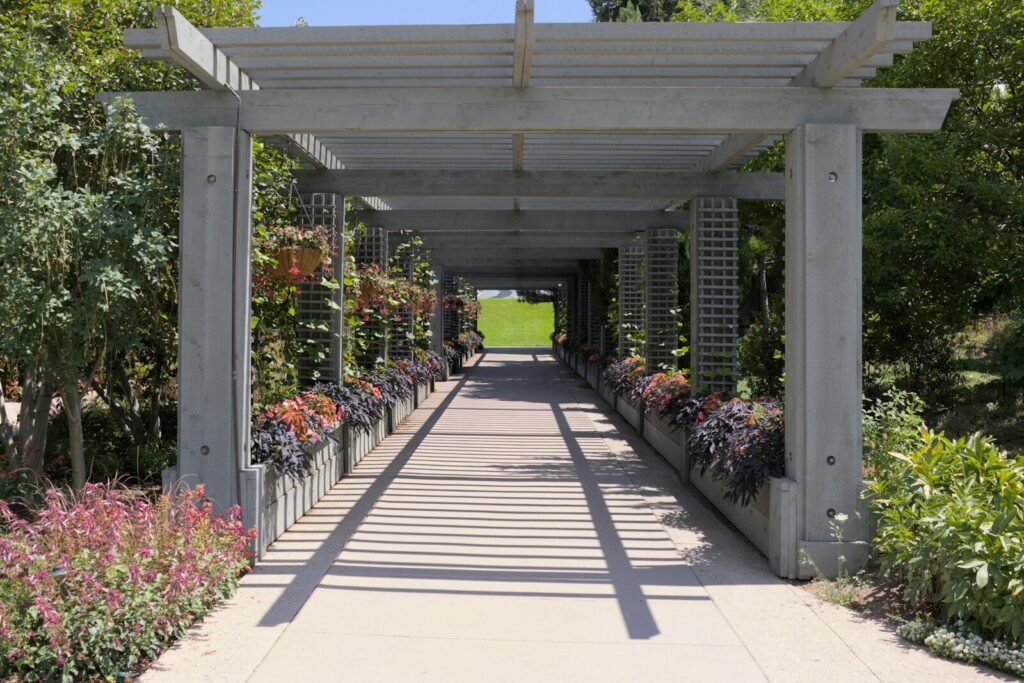
For most garden pergolas, pressure-treated softwood treated to Use Class 4 is the sensible default, with posts around 100 x 100 mm, beams around 47 x 200 mm and rafters around 47 x 150 mm. If you want something that looks heavier and weathers to silver without preservative, green oak is the traditional alternative, and larch or Douglas fir heartwood sit in between. The decision that matters most is how the posts meet the ground, because that is where pergolas rot first. Settle that before you choose a species.
The timber options
Durability classes below follow EN 350, where class 1 is very durable and class 5 is not durable. They apply to heartwood only. Sapwood of every species here is not durable, so it either needs treatment or keeping out of the posts.
| Timber | Natural durability (heartwood) | Best for | Watch for |
|---|---|---|---|
| Treated softwood (redwood, spruce) | Redwood class 3–4, Norway spruce class 4, so it relies on treatment | Posts, beams and rafters on a budget | Ask for UC4; treat every cut end |
| Green oak | Class 2 | A heavy, traditional look | Shrinks, splits and stains as it dries |
| European larch | Class 3–4 | Untreated beams and rafters | Knots and resin; check for heartwood |
| Douglas fir | Class 3 imported, class 4 home-grown | Long, straight beams | Ask where it was grown |
| Sweet chestnut | Class 2 | Posts and rustic frames | High in tannins, like oak |
Treated softwood is usually the cheapest option and the easiest to cut and fix. The Wood Protection Association defines Use Class 4 as timber “in contact with or very close to the ground and frequently wet”, and lists fence and deck posts under it. Ask for UC4 on the posts at least. The default treated service life is 15 years unless 30 years is specified, so ask which you are getting.
Green oak is oak sawn and used before it has dried, typically at 30% moisture content or more. It is easier to cut than dry oak. The catch is that it shrinks considerably as it dries, and as it does it develops splits and surface cracks (often called checks). On a pergola this is mostly cosmetic, but it means joints loosen a little, pegs and bolts may need tightening after the first summer, and big sections can twist. Air-dried oak moves less but costs more and is harder to work. Oak heartwood is rated durable, so it can be used without preservative.
Larch and Douglas fir are the middle ground. Their heartwood is moderately durable at best and lasts well above ground with good airflow, which makes them a good choice for beams and rafters where you would rather not use treated timber. For posts in or near the ground, they are less certain, so put them on raised shoes or use treated or oak posts.
Others worth knowing. Sweet chestnut behaves much like oak and suits rustic posts. Imported western red cedar is durable (class 2) but soft, so it suits slats better than posts.
Typical sections for a garden pergola
These are the sizes people commonly use for a garden pergola of up to about 3 m between posts, carrying climbing plants and nothing else. They are not engineered spans. If you want longer spans, a solid roof, polycarbonate sheets, a sail, a hanging swing, or the pergola is attached to the house, check the TRADA span tables or ask a structural engineer.
- Posts. 100 x 100 mm sawn treated is the common minimum. 125 x 125 or 150 x 150 mm looks more in proportion on a bigger frame and is usual in oak.
- Beams. 47 x 200 mm is typical, often fixed in pairs either side of the posts. A single 75 x 200 mm or a 150 x 150 mm oak beam is the alternative where beams sit on top of the posts.
- Rafters. 47 x 150 mm at around 500 to 600 mm centres, laid across the beams with overhangs at each end.
- Top battens or slats. 25 x 50 or 47 x 50 mm across the rafters if you want more shade or more support for climbers.
- Knee braces. 75 x 75 or 100 x 100 mm, about 600 mm long, cut at 45 degrees. They stop the frame racking sideways.
Planed (PAR) timber finishes a few mm under the nominal size, so a 100 x 100 mm PAR post may measure around 94 x 94 mm. That matters when you buy post shoes or brackets, which are sized to the actual timber.
Getting the feet right
Pergola posts nearly always fail at ground level, where they stay wet longest. You have two main options.
- Set in the ground with concrete. The traditional method. The Wood Protection Association warns against a concrete “boot” that holds water against the post. If you use concrete, set the post on a layer of gravel so its base can drain, and slope the top of the concrete away from the timber so water runs off. Use UC4 posts only.
- Steel post shoes or spikes. A galvanised shoe set in concrete, or bolted to a slab or patio, holds the post a little above the surface so the end grain stays out of standing water. This suits oak, larch and Douglas fir, which you would not want buried.
The Wood Protection Association is blunt about it: never put cut ends in the ground, even if end grain coated. If you shorten a treated post, cut from the top, and brush end-grain preservative on every freshly cut or drilled surface.
Fixings
Use hot-dip galvanised or stainless steel bolts, coach screws and brackets outdoors. Plain or bright zinc-plated steel rusts and stains quickly.
Oak and sweet chestnut need more care. Oak has a high tannin content, especially when green, and BM TRADA notes that these extractives are very corrosive to mild steel and that fixings in external oak should always be stainless steel or non-ferrous. In practice that means stainless bolts, or traditional oak pegs in mortise and tenon joints. Ordinary steel in oak leaves black stains that are very hard to remove.
Planning permission in England
In England, a freestanding garden pergola usually does not need planning permission, but it is not a free-for-all. Permitted development for structures in the garden (Class E) treats “building” as including any structure or erection, so the outbuilding limits are a reasonable guide. The Planning Portal sets out the main ones:
- Height near a boundary. Within 2 metres of a boundary, the maximum height is 2.5 metres. A pergola with 2.4 m of headroom will be over that once beams and rafters sit on top, so measure the overall height, not the post height, from the highest ground next to the structure.
- Height elsewhere. 3 metres overall, or 4 metres with a dual-pitched roof, with eaves no higher than 2.5 metres.
- Position. Nothing forward of the principal elevation (usually the front of the house).
- Coverage. No more than half the land around the original house covered by additions and other buildings.
The rules are tighter in some places. Within the grounds of a listed building, any outbuilding needs planning permission, and in conservation areas, National Parks, Areas of Outstanding Natural Beauty and World Heritage Sites there are extra restrictions. A pergola fixed to the house falls outside Class E, which excludes structures attached to the house, so different rules apply. If you are near any of these limits, or in a listed building or conservation area, check with your local planning authority before you order timber. Rules in Wales, Scotland and Northern Ireland differ.
A sample cutting list: 3 m x 3 m pergola
This assumes four treated softwood posts on bolt-down shoes, giving about 2.4 m to the underside of the beams, paired beams either side of the posts, rafters over the top and knee braces at every post. Lengths are what to order from the merchant. They allow for overhangs and trimming, not for the cut lengths themselves.
| Part | Qty | Section (mm) | Order length | Notes |
|---|---|---|---|---|
| Posts | 4 | 100 x 100 | 2.7 m | Allows for trimming and beam notches; order 3.3 m if setting about 600 mm into concrete |
| Beams | 4 | 47 x 200 | 3.6 m | Two each side, bolted through the posts, about 300 mm overhang each end |
| Rafters | 7 | 47 x 150 | 3.6 m | About 500 mm centres, about 300 mm overhang each end |
| Knee braces | 8 | 75 x 75 | 0.6 m each, or 3 x 2.4 m | Two per post, cut at 45 degrees |
| Top battens (optional) | 8 | 47 x 50 | 3.6 m | Across the rafters for shade and climbers |
To make your own list, sketch the frame from above and from the side, write down every piece with its finished length, then group pieces by section and round up to the lengths the merchant sells (commonly in 300 mm steps). Add one or two spare lengths of the most-used section, or around 10% extra, to cover a split board or a mis-cut. On top of the timber you will need four post shoes or bags of postcrete, M10 or M12 galvanised or stainless bolts through each beam and post junction, coach screws or rafter ties for the rafters, and a tin of end-grain preservative.
For a quote, the guide to what a timber merchant needs from you shows how to lay out a list like this so it is easy to price.
Build it: tutorials worth following
Free, independent build tutorials are thin on the ground for pergolas, so for now there is one worth following:
- How to Build a Pergola, DIY Doctor: a plain UK walk-through of a pergola built from scratch, with post and beam sizes, hole depths and how to notch the crossbeams over the beams. It sets the posts in concrete (or on metal bases bolted to a concrete pad), so follow the advice above on drainage, Use Class 4 and keeping cut ends out of the ground.
What to ask the merchant
- Is this treated to Use Class 4, and for 15 or 30 years? Posts near the ground need UC4. The longer service life needs a higher treatment level.
- Is it sawn or planed, and what are the actual sizes? Brackets and shoes are sized to the finished section.
- Is the oak green or air-dried? Green oak is easier to work but will shrink and split as it dries.
- How much of it is heartwood? For untreated larch, Douglas fir or oak, ask for pieces with as little sapwood as possible, especially for posts.
- Where was the Douglas fir grown? Home-grown can rate less durable than imported.
- Which end-grain preservative suits this treatment? You will need it for every cut.
Sources
- Planning Portal, Outbuildings: planning permission (permitted development height, position and coverage limits; listed buildings and designated land; applies to England)
- GOV.UK, Permitted development rights for householders: technical guidance (Class E; “building” includes any structure or erection; attached buildings excluded; height measured from the highest adjacent ground; 2.5 m within 2 m of the boundary; article 2(3) land)
- Wood Protection Association, Understanding Use Class 4 (WPA TW 8) (UC4 definition, posts under UC4, 15 and 30 year service life, avoiding concrete boots, end-grain treatment, never putting cut ends in the ground)
- BM TRADA, Back in the frame: green oak (green oak moisture content, shrinkage and splitting, tannins corrosive to mild steel, stainless or non-ferrous fixings)
- GreenSpec, Timber cladding: durability, quality and movement (EN 350 durability classes for oak, sweet chestnut, Douglas fir and western red cedar by origin)
- Swedish Wood (Svenskt Trä), Durability and resistance (EN 350 heartwood classes: pine and larch 3–4, spruce 4)