
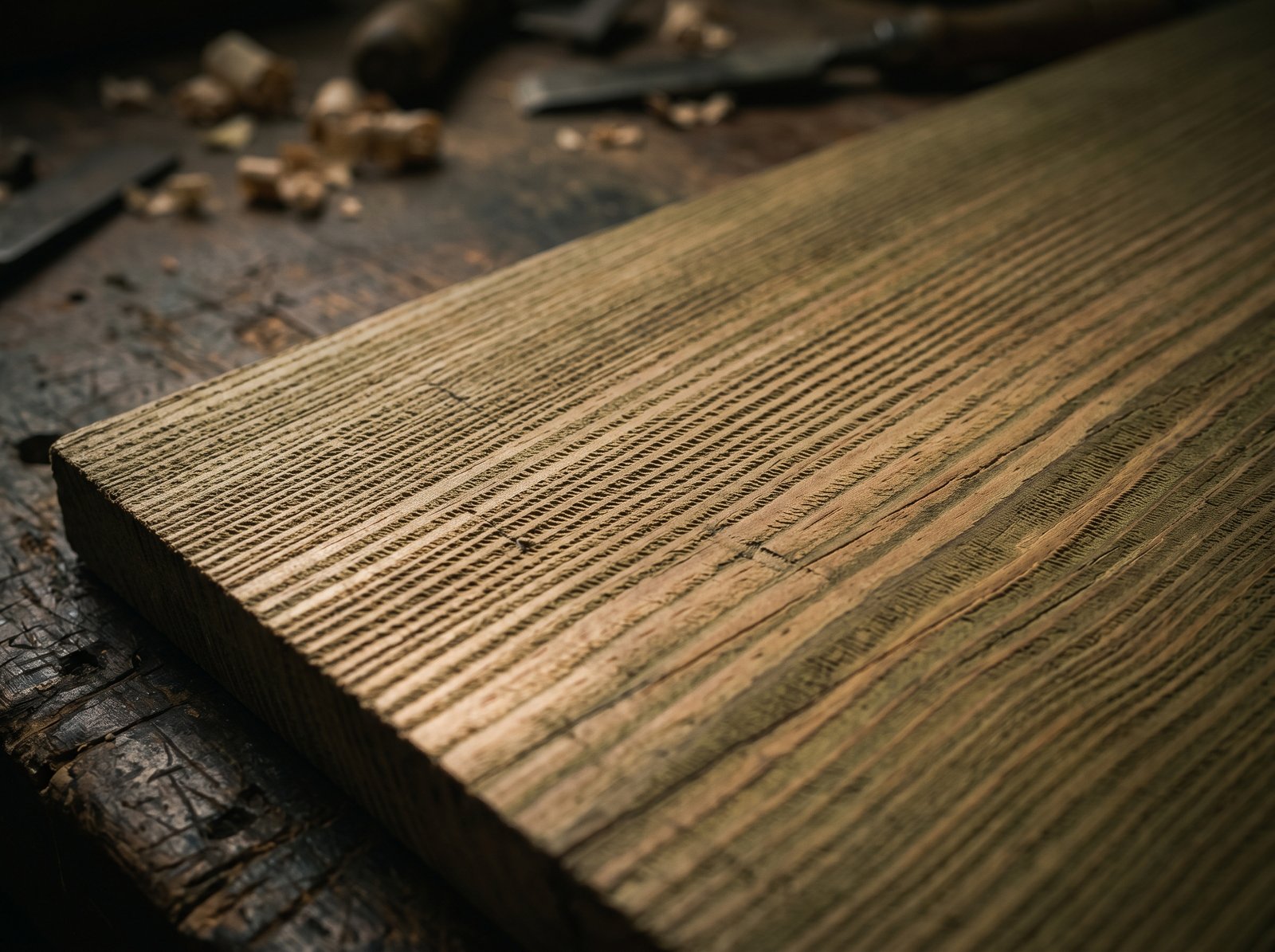
That’s not bad sanding. That’s two materials in the same board, and they don’t respond to abrasive the same way.
Two bands, two jobs
Earlywood goes on first, when the tree is growing hard. The cells are large, the walls are thin, and the result is a light, open, low-density band.
Latewood goes on later, when growth slows. Smaller cells, thicker walls, darker and denser. That’s the band that carries most of the strength.
Put together they make one growth ring — which is why rings read as a light band and a dark line, over and over down the board.
Why you can see them so clearly
It’s mostly a density difference, and density changes how wood handles light.
The denser latewood reflects light differently from the open earlywood, and it absorbs finish differently too. That’s why the bands stand out so plainly on plain-sawn timber, even in a species with no dramatic colour variation.
What this does under a sander
This is where earlywood and latewood stop being theory.
Latewood is harder and denser, so it resists abrasion. Earlywood is softer and more open, so it sands away faster. Work a board evenly and you’ll remove more of the earlywood than the latewood — which leaves the denser bands very slightly proud.
That’s the washboard effect. Run your hand across a planed or sanded softwood and you can feel the stripes. It shows up most on species with strong ring contrast — Douglas fir and pine are the classic offenders.
It matters because it’s visible the moment a finish goes on. Clear finishes exaggerate it: the raised latewood catches the light and the surface reads as rippled even though it looks flat to a straightedge.
What to do about it: work through the grits properly rather than jumping, keep the pressure even and light, and use a sanding block or a hard-backed pad on flat surfaces. A soft pad follows the ridges and makes it worse. If the surface has to be dead flat under a gloss finish, that’s a job for a sharp, finely set plane (or a cabinet scraper on hardwood) rather than paper.
And mind the dust. Use extraction or a properly fitted FFP3 mask when you sand. Wood dust can cause asthma, some species such as western red cedar are known for it, and hardwood dust is linked to nasal cancer. It’s the one thing in the workshop I’d never skimp on.
What it does under a plane
The same difference shows up in planing. Going with the grain on a strongly banded softwood, the cutting edge moves through alternating soft and hard material — you can feel the tool surge and ease as it crosses each ring.
That’s why some softwoods feel like they plane in stripes rather than in one smooth pass. It isn’t a blunt iron. It’s the timber.
Latewood proportion and strength
Here’s the claim that needs care taken with it.
You’ll read that woods with a higher proportion of dense latewood are stronger for their weight. There’s something in that — latewood is where the structural material is, and a ring that’s mostly latewood is a denser, tougher band of wood.
But the relationship is not universal, and it’s not a shortcut. Species anatomy matters more than any single indicator, and you can’t reliably rank two boards of different species by eyeballing the dark bands in them. Within one species, and between boards cut from similar trees, latewood proportion is a reasonable clue. Across species, it’s noise.
Treat it the way you’d treat ring width: a prompt to look closer, not a measurement you can act on.
Earlywood and latewood are not “hardwood and softwood”
These get tangled up, so it’s worth separating them cleanly:
- Hardwood vs softwood describes the type of tree — a botanical family.
- Earlywood vs latewood describes when the wood formed, inside a single ring.
Most temperate trees lay down both in every ring, and you’ll find earlywood and latewood in oak and in pine alike, though in some species the two are hard to tell apart. One is about what the tree is; the other is about when that particular wood was made.
What to take to the yard
A short version you can actually use:
- Feel the surface of a softwood before you buy it if appearance matters. Strong banding means more work to get a flat finish.
- Remember the washboard effect is a finishing issue, not a structural one — it doesn’t make the board weak.
- Don’t rank species by how dark their rings look. It’s not a reliable measure of much beyond the growing conditions.
None of this is about avoiding certain timber. It’s about knowing that the banding you can see is real structure, and that structure has consequences at the bench — usually manageable ones, once you know what you’re dealing with.
Next in the track
You now know what’s inside a ring and how each band behaves under a tool. Next, the property that ties all of this together and decides more about your work than anything else so far — the direction the fibres actually run: Episode 8: Grain Direction and Why It Matters.