
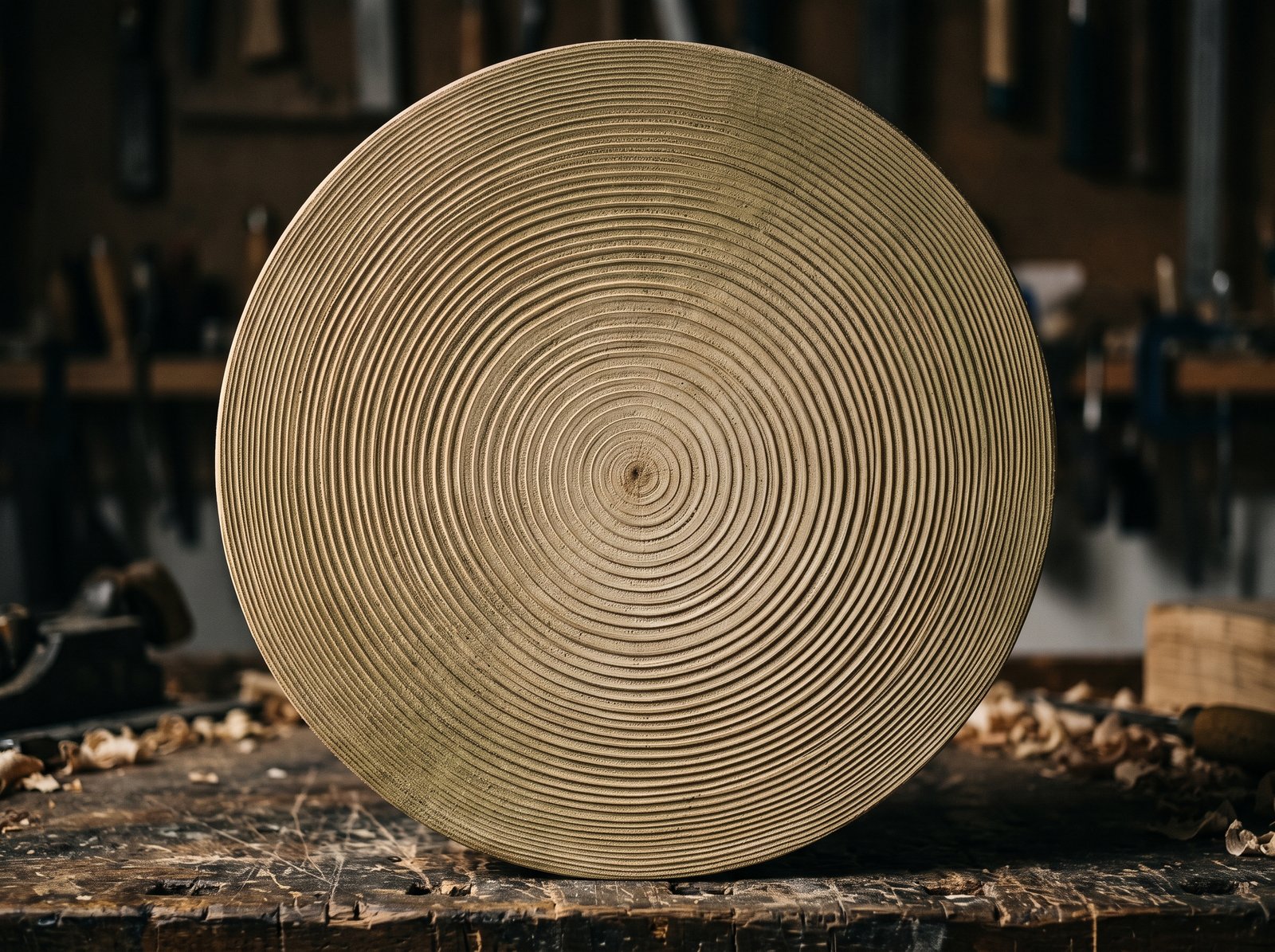
Most people know that trees have rings. Far fewer can look at the end of a board and say what the rings mean for the job they’re doing. That’s the useful skill, and it’s this guide.
What you’re actually looking at
The rings you see on end grain are the record of the tree’s growing seasons. Fast growth in the good months lays down one kind of wood; slower growth later lays down another. The contrast between those two is what makes a ring visible at all.
In most temperate species one ring is one season, so roughly one year — but it’s worth saying plainly that it isn’t a perfect clock. In the tropics, where growth is more even, rings can be faint or absent. And a tree that has a bad year can lay down a ring so thin you’d never spot it without help. Rings are a good record, not a guaranteed calendar.
What they are reliably is a record of conditions. A wide ring means the tree had the water and light to grow hard that year. A tight ring means it didn’t, or simply that the tree was older: rings naturally get narrower as the trunk gets bigger, because the same growth is spread round a wider circle. Neither is automatically good or bad — which is the thing most writing on this gets wrong.
The two bands inside every ring
Each ring is made of two zones, and they’re genuinely different materials:
- Earlywood forms when growth is fast. The cells are larger and thinner-walled, so the wood is lighter in colour and lower in density.
- Latewood forms when growth slows. Smaller cells, thicker walls — darker in colour, higher in density, and generally stronger.
That’s why rings read as alternating light and dark bands. You’re looking at the difference between a season of easy growth and a season of harder work.
Douglas fir is a good species to see this on, because its latewood band is pronounced and the contrast is clear without any magnification.
Ring width: the most over-claimed shortcut in timber
You’ll hear it repeated everywhere: tight rings mean better timber. Slow-grown, dense, strong. Wide rings mean cheap, fast-grown rubbish.
There’s something behind it — slow growth often does correlate with denser wood in certain softwoods. But as a general rule it falls apart quickly, and it’s worth knowing why before you use it to refuse a board.
- It varies by species. The correlation holds better in some softwoods than in others. In oak and ash it actually runs the other way: wider rings, denser and stronger wood. And in hardwoods like beech and birch there’s barely a link at all.
- On its own it’s a poor guide to stability. Ring width won’t tell you how much a board will move or whether it’ll stay flat. The exception is very wide rings near the centre of a softwood log, which often mean juvenile wood, and that does misbehave (more on that at the end of this track).
- Uneven rings aren’t a defect. They mean the tree had a varied life — drought years, competition, damage. That’s a story, not a fault.
Where rings do earn their keep is comparison. Put two boards of the same species side by side and look at the end grain. If they feel different in the hand, the rings often explain why. That’s the honest use of the skill — a clue that prompts a question, not a verdict you can skip the question with.
What the ring pattern tells you about how a board was sawn
This is where growth rings become genuinely practical, and it’s about geometry rather than age.
When a log is sawn, the rings get sliced at an angle. That angle is fixed for the life of the board, and it does two things: it creates the grain pattern you see, and it decides how the board will move.
- Flat-sawn — rings cut at a tangent, showing as wide arcs. The face shows cathedral grain, and the board is more prone to cupping.
- Quarter-sawn — rings cut closer to vertical. Straighter, more parallel grain on the face, and usually more stable across the width.
- Rift-sawn — rings at roughly 30–60° to the face, somewhere between the two. Very even grain, but wasteful to produce, and in a UK yard you’ll mostly meet it on American white oak, sold as “rift and quartered”.
So the arcs on the end of a board aren’t decoration. They’re a diagram of how that particular piece was cut out of the log.
Why this predicts cupping
Wood moves more around the curve of the ring than it does across them. That difference matters when the rings are arched through a board’s width.
A flat-sawn board has rings curving through it, which means its movement is uneven across the width — one face shrinks slightly differently from the other. The result is cupping: as it dries, the board curves in the direction that flattens those arcs.
Quarter-sawn boards have the rings running closer to perpendicular through the thickness, so the movement is more even, and the board stays flatter.
Once you know this, you can pick up a board and predict which way it wants to go before you’ve cut anything. Sight down the end grain: strongly arched rings mean more cupping risk, near-vertical rings mean a calmer board. That’s a five-second check at the stack, and it’s worth doing on anything going into a tabletop or a door.
Same tree, different boards
Because the rings are arcs through the log, boards cut from different positions come out differently. Boards near the outside are more flat-sawn. Boards nearer the centre, cut through the arcs, are closer to quarter-sawn in behaviour. The very centre board is the exception, because that one carries the pith, and the pith is trouble.
Which is the answer to a question that confuses a lot of people buying timber: why two boards from the same tree, same species, same thickness, can behave like different materials. They are different materials. The rings in them sit at different angles.
Next in the track
You can now read a ring for how a board was cut and how it’ll move. But there’s another division inside the trunk that matters just as much — this one an inner core and an outer band, rather than a yearly ring. Next, Episode 6: Heartwood vs Sapwood.