
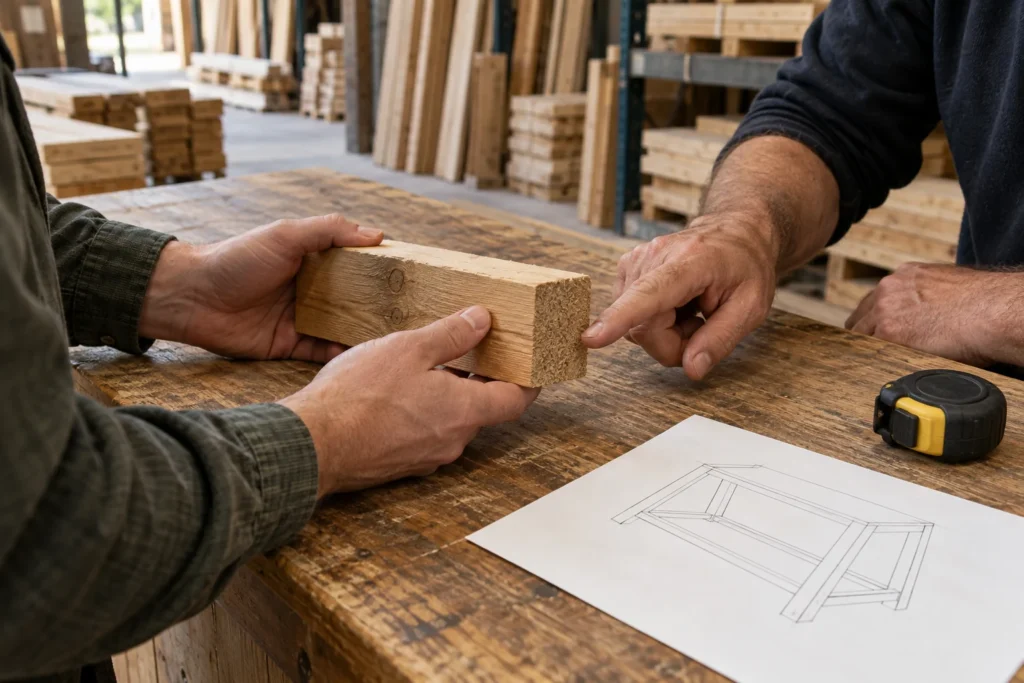
You do not need to know every trade term before contacting a timber merchant. You do need to explain the job clearly enough for the person at the other end to identify what matters, what is still undecided and which products might suit.
A useful enquiry is not necessarily a formal specification. It can be a short email, a cutting list, a few photographs or a conversation at the counter. The important thing is that it describes what the timber has to do rather than asking the merchant to guess from a familiar name such as “4 × 2”, “hardwood” or “something for outside”.
This guide is about that first useful exchange. 5. How to Specify Timber for a Quote goes further, turning settled requirements into a formal document that several suppliers can price on the same basis.
1. The short answer
A timber merchant normally needs to know:
- What you are making.
- Where the timber will be used.
- Whether the work is structural.
- The required supplied dimensions.
- The component lengths and quantities.
- Whether species, grade or appearance is fixed.
- The moisture, durability or treatment requirement.
- Any cutting, machining or profiling needed.
- When and where the timber is required.
- Which details are essential and which may change.
You can still ask for help when some of those answers are unknown. Mark them as unknown or flexible rather than filling the gaps with terminology you are unsure about.
A clear statement of the job is more useful than an incorrect product name.
2. Begin with one sentence about the project
Start with what the timber is for:
I am making two painted alcove units for a heated room.
I am replacing an exterior gate post that will be set in the ground.
I need the structural timber listed on the attached engineer’s drawing.
That sentence tells the merchant which questions to ask next. It can establish whether appearance matters, whether the timber must carry a load, whether moisture condition is important and whether natural durability, preservative treatment or a modified product may be needed.
Avoid beginning with a product name unless you know it is correct. “I need cedar” may close off useful alternatives before the merchant understands the job. “I need cladding for an exposed garden room, left unfinished” explains the requirement while leaving room for a sensible discussion.
3. Say where the timber will live
The same species and section can be suitable in one environment and wrong in another. State whether the timber will be:
- inside a heated building;
- inside the building envelope but exposed to occasional moisture;
- outside and above ground;
- close to or directly in contact with the ground;
- in fresh water;
- regularly or permanently exposed to salt or brackish water;
- coated, left unfinished or maintained under a stated system.
For exterior work, describe water traps, end-grain exposure and whether failure would be merely inconvenient or safety-critical. A fence board, an exterior load-bearing post and a marine pile are not interchangeable simply because all three are outdoors.
The use classes in BS EN 335 describe exposure, not how long a particular product will last. Where preservative-treated timber is being specified, the merchant may also need the desired service life and written confirmation that the supplied treatment meets the required use class. Natural durability, preservative treatment and wood modification are different ways a complete product may achieve the required performance.
Do not ask only for “treated timber”. Ask what the product is treated for.
4. Make structural requirements explicit
If the timber will carry load, say so at the start. Structural timber must meet the design rather than merely look substantial or fit the available space.
Give the merchant the relevant information from the approved design:
- strength class, such as C16 or C24, where specified;
- target section and tolerance;
- lengths and quantities;
- species or species group, if restricted;
- treatment or service requirements;
- any standard, drawing reference or special marking requirement.
A merchant can explain what is stocked and may suggest a compliant alternative for the designer to consider. The merchant should not be expected to determine joist spans, beam sizes, connection design or whether a smaller section is safe.
For structural timber, confirm the grade marks and accompanying product information required for the job. Do not accept an unmarked lookalike because it has the same dimensions.
Some products have their own requirements. Roofing battens, for example, are safety-critical and must be correctly sized, graded and marked to BS 5534; a general-purpose batten of similar size is not an automatic substitute.
5. Give the supplied size, not just the familiar name
Write dimensions in millimetres and label them:
Finished thickness 20 mm × finished width 45 mm × length 2,100 mm.
State whether the section is:
- sawn;
- regularised structural timber;
- CLS;
- planed all round or planed square edge;
- a named moulding or cladding profile;
- a sheet or panel product.
If the size is critical, include the acceptable tolerance or the opening it must fit. “4 × 2” can describe products with different actual sections, and an ex-sawn size does not guarantee one universal finished size.
For profiled products, a simple width and thickness may not be enough. Cladding, flooring and mouldings may also need a profile drawing, cover width, tongue or overlap dimensions, orientation and a sample approval.
If you do not know the correct section, give the merchant the measurements and photographs described in 3. How to Order Timber When You Don’t Know the Correct Size. For structural work, the required size still has to come from the design.
6. Send component lengths and quantities
“About thirty metres” is less useful than a component list. The same net length can require very different amounts of stock depending on how the parts fit into the available lengths.
A basic list might look like this:
| Component | Supplied section | Finished length | Quantity | Notes |
|---|---|---|---|---|
| Face-frame stile | 20 × 45 mm finished | 2,100 mm | 8 | Visible, painted |
| Face-frame rail | 20 × 45 mm finished | 1,200 mm | 6 | Visible, painted |
Keep different sections, species, grades and treatments on separate lines. For sheets, include the required part dimensions, face or grain direction and whether pieces may be rotated.
Tell the merchant whether:
- fixed lengths are essential;
- a mix of stock lengths is acceptable;
- random-width or random-length boards can be used;
- whole boards or full sheets may be bought;
- the merchant may optimise the cutting pattern;
- the stated quantity already includes contingency.
4. How Much Timber Do I Need explains how to turn finished components into a purchase list that includes stock lengths, kerf, trimming, usable yield and a separate contingency decision.
7. Name the species—or state what may vary
If the design, client or appearance requires a particular species, name it. Where a trade name may cover more than one species, ask the merchant to identify what is actually being offered.
If species is flexible, explain what must remain equivalent. Depending on the job, that may include:
- natural durability and desired service life;
- structural performance;
- movement and stability;
- density or weight;
- colour and grain;
- ability to take a coating or preservative treatment;
- machining and fixing behaviour;
- certification or origin requirements;
- availability in the required section and length.
“Cedar or equivalent” does not define those things. A better request is:
Please quote the named species and identify any alternative separately, stating how it differs in durability, movement, appearance, available sizes, maintenance and price.
That leaves room for the merchant’s knowledge without allowing a silent substitution.
8. Explain what appearance matters
Appearance requirements need to be practical and observable. “Nice boards” and “best quality” mean different things to different people.
Tell the merchant:
- which faces and edges will be visible;
- whether the timber will be painted, coated or left clear;
- whether knots are acceptable and, if so, where;
- whether sapwood, wane, pith, splits or checks are restricted;
- whether colour and grain must match within a set;
- the clear cutting lengths needed from each board;
- whether you want to select boards in person;
- whether an agreed appearance grade or sample is available.
Do not use structural grades as appearance grades. C16 and C24 describe structural performance, not how clean or attractive a piece will look. Equally, an attractive board is not structurally graded unless it has been assessed and marked for that purpose.
For important visible work, a sample, board photographs or agreed selection criteria may communicate more than a vague adjective.
9. State the moisture condition and final environment
“Kiln dried” describes a drying process; it does not guarantee one universal moisture content or that the timber has remained at its original target during storage.
Tell the merchant where the timber will settle in service:
- heated interior;
- unheated interior;
- workshop or outbuilding;
- exterior under cover;
- exterior exposed to weather.
For furniture, joinery, flooring or other movement-sensitive work, ask for the target or current moisture range to be stated and discuss acclimatisation before final machining. For structural timber, use the moisture condition required by the design and product specification.
Do not demand an arbitrary number copied from another project. The appropriate condition depends on the product, intended environment and applicable standard.
10. Be precise about machining and cutting
List each service required:
- planing to a finished thickness and width;
- straight-line edging;
- ripping to width;
- cross-cutting to rough or finished length;
- moulding or profiling;
- rebating, grooving or drilling;
- panel cutting;
- sanding or another surface finish;
- preservative treatment after permitted machining, where available.
Give the finished dimensions and tolerance rather than saying “plane it up”. Identify any face that must be kept, any profile orientation and whether machining marks will remain visible.
Ask whether a cutting service provides transport cuts or finished components. A panel saw used to make a sheet fit the vehicle is not automatically a cabinet-making service.
Machining can affect yield, structural validity and preservative protection. A rough board may not clean up to the desired section, substantial machining of strength-graded timber needs competent confirmation, and site cutting of treated timber must follow the product manufacturer’s instructions.
11. Mention documentation that the job requires
Some requirements are only useful when they appear on the paperwork.
Depending on the project, ask for:
- structural strength class and grade marking;
- treatment use class and, where required, a treatment certificate or written confirmation;
- declared species or species group;
- moisture or drying information;
- product standard or manufacturer reference;
- FSC or PEFC claim;
- country or region of origin where relevant;
- batch, profile or colour reference needed for later matching.
If a project requires a formal FSC claim, specify it when ordering and check that the sales or delivery documents identify the certified product, the claim and the supplier’s certificate code. PEFC claims likewise depend on valid chain-of-custody documentation. An already labelled retail product bought by an end consumer does not always require the same paperwork, so explain what evidence your project actually needs.
12. Give the date, postcode and access details
Availability cannot be separated from timing and delivery.
State:
- the date the timber is required;
- whether that date is fixed or flexible;
- delivery or collection;
- the delivery postcode;
- the longest and heaviest items;
- narrow roads, gates, parked cars or overhead restrictions;
- whether mechanical offload is required or available;
- who will be present to receive the order;
- where the timber can be stored level, supported and protected.
Ask the supplier to state the lead time, its starting point and the expected collection or delivery date. “Usually a week” may depend on deposit, drawing approval, machining capacity or the next delivery run.
Also ask for the total price and whether it includes VAT, machining, delivery, offloading, packaging and any minimum-order charge. Do not compare a collected ex-VAT rate with a delivered VAT-inclusive total.
If collecting, check the vehicle’s capacity and how the load will be secured. The fact that a length can physically project from a vehicle does not make the load safe or legal.
13. Photographs and samples: what helps
A merchant can often identify a product family or ask better questions from good photographs.
Send:
- the whole item or opening in context;
- the face of the timber with a rule or tape visible;
- the complete end grain and cross-section;
- any stamp, treatment mark, label or packaging;
- damage or decay you are trying to replace;
- adjoining boards when colour or profile matching matters.
Photograph the tape square-on and write the measurements separately. Perspective can make a dimension look larger or smaller than it is.
Bring an offcut or sample when practical. Keep it labelled so nobody mistakes it for an approved structural or species identification. A photograph or offcut alone cannot prove a strength class, treatment specification or species with certainty.
14. Separate essentials from preferences
The most helpful enquiries show the merchant where alternatives are possible.
| Essential | Flexible |
|---|---|
| Required structural class and section | Stock length used to yield the parts |
| Actual finished size for a fitting | Nominal starting size |
| Treatment use class for the exposure | Preservative brand, unless specified |
| Clear visible face on a component | Natural colour variation within agreed limits |
| Fixed completion date | Collection or delivery date within an acceptable range |
| Required certification claim | Species, if performance and appearance requirements are met |
Do not mark something flexible if changing it alters the design or requires client, engineer or building-control approval. A merchant can propose an alternative; the person responsible for the design must approve it where necessary.
15. Three useful enquiries
A small non-structural job
I am making two painted alcove units for a heated room. I need planed softwood with a finished section around 20 × 45 mm: eight components at 2.1 m and six at 1.2 m. The visible faces should be reasonably straight and clean, but species is flexible. Please confirm the nearest stock or machined section, moisture condition, available lengths, machining charge, VAT and delivery to [postcode].
Structural timber from a design
Please quote the structural timber on the attached engineer’s schedule. The strength classes, target sections and quantities are fixed. Identify any proposed substitution or dimensional change separately for approval before ordering. Please confirm grade marking, treatment where scheduled, delivery documentation, VAT, lead time and delivery to [postcode].
Exterior timber where the material is open
I am making an exterior slatted screen above ground, exposed to weather and left unfinished. Finished slats are approximately 20 × 45 mm; the cutting list is attached. I am open to species, preservative-treated or modified options suitable for the exposure. Please state the species or product, durability approach, use-class treatment where applicable, desired service-life information, moisture condition, available lengths, fixing considerations, maintenance, VAT and delivery.
Each enquiry explains the job, fixes what cannot change and invites alternatives without hiding the differences.
16. Questions the merchant may ask you
A good merchant may come back with questions rather than an immediate price:
| Question | Why it matters |
|---|---|
| Is the work structural? | Determines whether a designed and graded product is required |
| Are those nominal or finished dimensions? | Prevents the wrong section being supplied |
| Which faces are visible? | Affects grade, selection and machining |
| Can the species or stock length change? | Opens better-value or better-yield options |
| Is the timber inside, outside or in ground contact? | Establishes the durability or treatment requirement |
| What moisture condition is needed? | Reduces movement problems in service |
| Are fixed lengths essential? | Affects yield, stock availability and price |
| Do you need documented certification? | Determines the required supplier and paperwork |
| Can a large vehicle reach the site? | Determines whether and how delivery is possible |
Those questions are not an attempt to make the order difficult. They are the gaps that separate a product name from timber fit for a particular job.
17. What the merchant’s answer should confirm
Before placing an order, make sure the reply identifies:
- the exact product, species or trade group being offered;
- supplied dimensions and applicable tolerance;
- available lengths and quantity;
- grade and appearance basis;
- moisture, treatment or durability information;
- machining and selection included;
- any alternative or departure from the request;
- unit price and total price;
- VAT, delivery, offloading and other charges;
- lead time and expected date;
- certification, grade or treatment paperwork requested.
If the merchant has sensibly changed the proposed stock length to improve yield, that is not a problem. A silent change to grade, section, treatment or species may be.
Guide 5 explains how to turn those requirements into a fixed request that several suppliers can quote comparably: 5. How to Specify Timber for a Quote.
18. Copy-and-paste merchant enquiry
- Project:
- Where the timber will be used:
- Structural or non-structural:
- Drawing, standard or fixed specification:
- Species or acceptable alternatives:
- Required grade or appearance:
- Sawn or finished dimensions:
- Component lengths and quantities:
- Moisture condition:
- Natural durability, treatment or use class:
- Machining or cutting required:
- Certification or documentation required:
- Essential details that must not change:
- Details that are flexible:
- Required date:
- Delivery postcode and access:
- Please confirm: exact product, supplied dimensions, tolerance, available lengths, unit and total price, VAT, delivery, lead time and any departure from this request.
Attach the component list, drawing, photographs or product reference that make those answers easier.
Where these requirements come from
There is no single mandatory form for asking a timber merchant a question. The checklist brings together the information needed to identify the product, its intended use, the quantity and the services surrounding the order.
The technical distinctions behind it come from the same standards and industry guidance used throughout this series:
- Structural strength classes and marking: BS EN 338 and BS EN 14081, with practical guidance from Timber Development UK.
- Structural sizes and tolerances: BS EN 336.
- Natural durability: BS EN 350.
- Use classes: BS EN 335.
- Preservative treatment and desired service life: BS 8417 and Wood Protection Association guidance.
- Drying quality: BS EN 14298; this assesses drying quality rather than imposing one moisture target on every use.
- Certified-material claims: FSC and PEFC chain-of-custody requirements for claims passed through sales and delivery documents.
Technical references
- Timber Development UK: dimension timber
- Timber Development UK: C16 and C24 timber
- Wood Protection Association and TDCA: buyer’s guide to preservative-treated wood
- TDCA: treatment use class and desired service life
- FSC UK: specifying and verifying FSC-certified timber
- PEFC UK: chain-of-custody certification
The merchant’s knowledge is most valuable when the intended job and constraints are visible. It does not replace structural design, a product standard or approval required elsewhere in the project.