
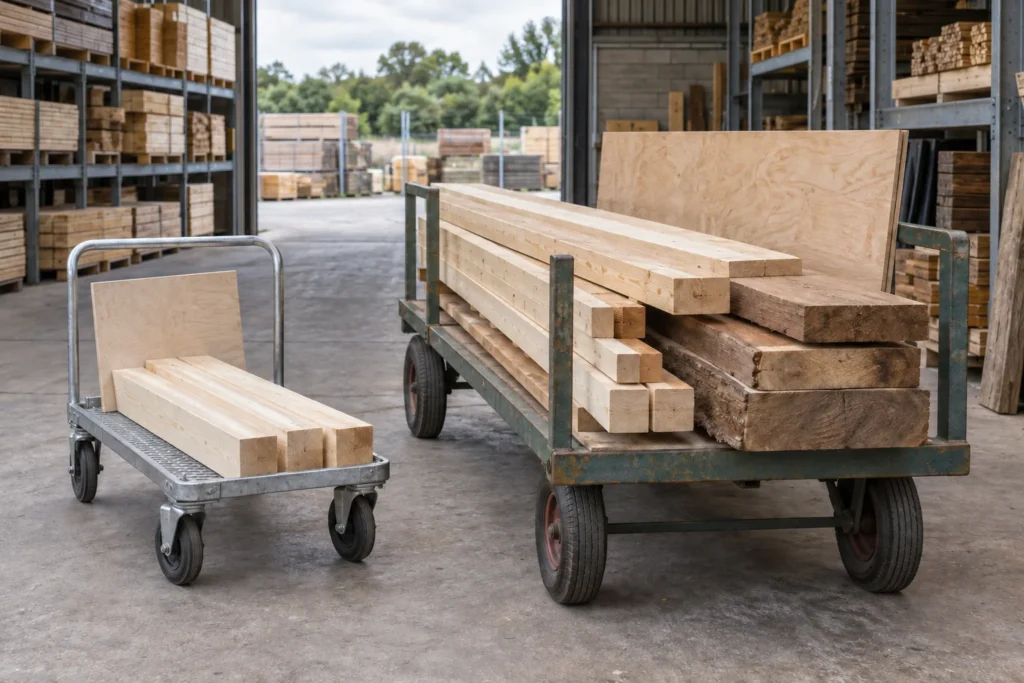
Start with a DIY store when you need a small quantity of standard timber quickly, particularly if loose stock is available to inspect. Start with a suitable timber merchant when size, grade, species, quantity, machining or specialist advice matters. Neither is automatically cheaper: compare the cost of getting usable timber in the form you need, not the shelf price.
Both can sell you a length of wood, but they are usually built around different kinds of customer and order. DIY stores make common products easy to find and take home. Specialist timber merchants tend to hold broader or deeper stock, while builders’ merchants concentrate more on construction products. Either may sell to trade and retail customers, and some businesses combine all three models.
This guide is about choosing between them — what each is actually for, how the range and the staff differ, what you can and cannot get at each, and what the difference costs you in time. It is not a ranking, and it names no shops. The right choice depends less on whether you are a “proper woodworker” and more on the job in front of you.
1. At a glance
| If you need… | Usually start with… | Why |
|---|---|---|
| One or two standard lengths today | DIY store | Convenient, visible prices and immediate collection |
| Structural timber to a stated grade | Either—check the product | The grade mark and documentation matter more than the type of shop |
| Hardwood boards or an uncommon species | Specialist timber merchant | Wider species, thicknesses and grades |
| A full sheet cut for transport | Either—check locally | Cutting services and accuracy vary by branch |
| Timber planed to a particular finished size | Timber merchant | Machining is more likely to be available |
| To inspect every individual piece | DIY store or merchant with self-selection | Access policies differ |
| A large landscaping or building order | Timber merchant | Pack quantities, delivery and volume pricing |
| A decorative moulding in a common profile | DIY store | Easy identification and small-quantity purchase |
| Advice on a substitute species or section | Timber merchant | More scope to match performance and availability |
| A small weekend repair | DIY store | Speed may matter more than unit price |
This is a starting point, not a rule. Some independent merchants welcome tiny orders; some large DIY stores carry specialist products; some retail timber yards combine both models.
2. What is a timber merchant?
A timber merchant is a specialist supplier whose main business is timber and related products. Depending on the yard, it may serve builders, joiners, furniture makers, landscapers, manufacturers and the public.
A builders’ merchant is not necessarily a timber merchant, although it may carry construction timber, treated sections, fencing and sheet materials. A joinery or hardwood merchant may focus on dried boards, specialist species and machining. A sawmill may sell locally sawn or less processed timber. These suppliers overlap, but they are not interchangeable, so look for one that routinely handles the kind of material your project needs.
A merchant may offer:
- structural softwood in multiple grades and sections;
- treated timber for specified end uses;
- hardwoods by species, grade, thickness or board;
- cladding, decking, flooring and mouldings;
- sheet materials in several constructions and grades;
- planing, thicknessing, straight-line edging or profiling;
- cross-cutting, ripping or panel cutting;
- delivery by suitable vehicles;
- help translating a cutting list into an order.
Not every merchant offers every service. “Timber merchant” tells you the type of business, not the exact stock or facilities.
3. What is a DIY store?
A DIY store is a broad home-improvement retailer. Timber is one department alongside tools, paint, plumbing, hardware and other building products.
Its timber range is usually designed around common household, repair and building tasks. Products tend to be labelled, barcoded and priced by the piece or pack. This can make a small order much easier for a beginner.
A DIY store may carry:
- common planed softwood sections;
- construction timber in popular sizes;
- skirting, architrave and standard mouldings;
- fence posts, rails, decking and treated landscaping timber;
- plywood, MDF, OSB and chipboard sheets;
- small hardwood strips or boards;
- short project panels and pre-cut pieces.
The trade-off is a narrower choice of species, grades, lengths and machining options.
4. Retail product versus timber specification
In a DIY store, you generally choose from standard retail products: a labelled length with a stated use, size and price. Its product page or label may still contain a detailed technical specification.
At a specialist merchant, you are more likely to begin with your own requirements and ask the supplier to match them to stock. The conversation may include:
- species or species group;
- strength or appearance grade;
- sawn, planed or profiled finish;
- nominal and finished dimensions;
- fixed or random lengths;
- moisture condition;
- treatment and intended use;
- quantity by piece, linear metre, square metre or cubic metre;
- machining, selection and delivery.
This can initially feel less convenient, but it can give you more control. Many merchants also sell standard stock products, so the distinction is a tendency rather than a rule. In either case, give the supplier enough information to identify the right material rather than relying on a familiar product name.
5. Range and availability
DIY store
The range is deliberately limited to products that sell regularly. That is useful when your design can follow the stock. If the store carries planed 18 × 44 mm softwood, designing around that actual size may be simpler than chasing a custom section.
Stock is usually easy to check online, although a system showing “in stock” does not guarantee that every piece is straight, undamaged or suitable for visible work.
Timber merchant
A merchant may hold many more sections, lengths, species and grades, or may be able to obtain them through established suppliers. It may also carry stock that is not fully represented online.
The range can be deeper rather than more retail-friendly. A merchant may have several grades of one product but no small hobby-sized pieces. It may sell hardwood in random widths and lengths rather than neat, identical boards.
Better question: not “Who has more timber?” but “Who stocks this kind of timber in a form you can use?”
6. Sizes: nominal, sawn and finished
Size descriptions cause more confusion than almost anything else in timber buying.
A DIY product label commonly shows the finished dimensions, but it may also include a familiar nominal description. Check which figure is the actual size.
A merchant quote may begin with a sawn or nominal size and show a smaller finished size after planing. For example, a section ordered from 50 × 25 mm sawn stock may finish appreciably smaller. The exact result depends on the supplier and machining process; there is no safe universal conversion.
Ask both suppliers:
- What are the dimensions of the piece that will be supplied?
- Is that measurement nominal, sawn or finished?
- What tolerance should be expected?
- Are all pieces intended to be the same finished size?
If your joint, bracket or opening requires a true dimension, state it explicitly. (See 3. How to Order Timber When You Don’t Know the Correct Size.)
7. Quality and grading
“Merchant quality” is not automatically excellent, and “DIY-store timber” is not automatically poor. Quality has to be judged against a clear requirement.
Structural timber
For load-bearing work, use the grade and specification required by the design. Common strength classes such as C16 and C24 refer to structural performance, not beauty. A strength-graded piece may contain knots or have an appearance that would disappoint in furniture while remaining appropriate for its structural use.
Do not substitute a different grade, species, thickness or depth simply because it looks substantial. Where structural requirements are unclear, check with the designer, engineer or building professional.
A specialist merchant may offer more grades, sections and supporting documentation, but correctly marked structural timber can also be bought from a DIY retailer or builders’ merchant. Check the grade mark and product information rather than judging compliance by the type of supplier.
Joinery and furniture timber
Visible work depends on features that structural labels do not describe:
- knot size and position;
- sapwood and colour variation;
- straightness of grain;
- pith, splits and checks;
- wane;
- staining, dents or sticker marks;
- board width and clear cutting length;
- matching between adjacent boards.
A specialist merchant may offer appearance grades or select boards for a cutting list. When loose stock is accessible in person, a DIY store may let you inspect individual pieces, which can work well for a very small project.
The crucial measure is usable yield: how many required parts can be cut from what you buy?
8. Straightness, movement and moisture
All solid timber can bow, cup, twist or crook. Storage, drying, grain and changes in humidity all play a part.
In a DIY store, you can often sight along each piece and reject obvious distortion before purchase. This is valuable when buying only a few lengths. The disadvantage is that popular racks may have been repeatedly picked through, leaving less desirable pieces.
At a merchant, timber may be supplied from a pack rather than chosen piece by piece. Some yards allow self-selection; others charge for selection, restrict access for safety or expect the customer to take material to the agreed grade. Ask before arriving.
Moisture condition matters as much as straightness. Interior joinery normally needs timber at a moisture content appropriate for a heated building. “Kiln-dried” describes part of the processing history; it does not guarantee the timber’s moisture content when delivered, because timber can take up moisture again during storage. For sensitive work, ask about the current or target moisture content and allow the timber to acclimatise before final machining.
Outdoor material needs suitable natural durability or preservative treatment, together with construction details that shed water and permit drying. For treated timber, ask for the use class appropriate to the exposure. In common UK applications, UC3 covers exterior timber above ground and UC4 covers timber in contact with the ground or fresh water. A brush-on cut-end treatment does not upgrade inadequately treated timber to UC4.
Useful questions include:
- Is it kiln-dried, air-dried or green?
- What use is the stock intended for?
- How has it been stored?
- Should it acclimatise before final machining?
- What use class or natural durability is required for the actual exposure?
“Dry”, “treated” and “exterior” are not complete specifications by themselves.
9. Price: which is actually cheaper?
There is no reliable winner without comparing the whole order.
Why a DIY store can be cheaper
- You need one or two pieces and can avoid a minimum order.
- The store is nearby and collection costs little.
- The product is already planed, labelled and ready to use.
- You can select pieces with little waste.
- A small off-the-shelf panel avoids buying a full sheet.
- A retail promotion happens to match the job.
Why a timber merchant can be cheaper
- You need many lengths or sheets.
- The unit price improves with quantity.
- Longer stock gives a better cutting yield.
- The merchant has the right grade instead of an expensive general-purpose product.
- Machining saves time, tooling and waste.
- A substitute species or section performs equally well for less money.
- Delivery consolidates a large order.
Compare like with like
For each quote, record:
| Cost or condition | Supplier A | Supplier B |
|---|---|---|
| Actual finished dimensions | ||
| Supplied length, area or volume | ||
| Grade/specification | ||
| Machining included | ||
| Expected waste | ||
| Minimum quantity | ||
| Delivery | ||
| VAT | ||
| Total usable components |
A low price per metre is meaningless if the section is smaller, the lengths do not suit the cutting list or several pieces are unusable.
10. How timber is priced
DIY stores usually price standard timber by the piece, pack or sheet. This is easy to understand: you can see the exact price before checkout.
Merchants may price timber by:
- piece;
- linear metre;
- square metre;
- cubic metre;
- sheet;
- pack;
- a machining charge plus the raw timber.
Hardwood may be quoted from sawn volume even when you ultimately need planed components. Random widths and lengths can make the total less obvious until boards are measured.
When requesting a quote, ask:
- Is the quantity based on sawn or finished dimensions?
- Are fixed lengths guaranteed?
- Must the whole available board or length be bought?
- Is machining charged by piece, metre, setup or volume?
- Are VAT and delivery included? (See 1. How to Buy Timber: A Beginner’s Guide for the units.)
11. Cutting and machining services
A cutting service can be the deciding factor, especially if you lack a van or workshop machinery.
DIY-store cutting
Some branches cut sheet materials to make them easier to transport. Policies vary. The service may have limits on material type, minimum cut size, number of cuts and guaranteed accuracy.
Treat a transport cut and a cabinet-quality finished cut as different things. Ask about tolerances and blade condition if the edge will be used directly.
Merchant machining
A merchant may offer:
- planing to a finished thickness and width;
- straight-line edging;
- ripping boards into narrower strips;
- cross-cutting to rough or finished length;
- moulding and profiling;
- rebating, grooving or matching cladding profiles;
- treatment after cutting, where relevant and available.
Machining is not magic. A bowed rough board may not produce the full requested section once made straight. The merchant may need to start with thicker or wider stock, and some defects remain acceptable within the agreed grade.
Give finished sizes, lengths and tolerances—not just a sketch with overall project dimensions.
12. Advice and technical knowledge
A knowledgeable merchant can be particularly useful when you know the performance required but not the product name.
For example:
I need timber for an exposed slatted screen, clear of the ground. It will be left to weather, and I want to minimise staining around the fixings. The slats finish at roughly 20 × 45 mm. What do you stock that would suit?
This invites a useful conversation about durability, treatment, movement, fixings, available sections and maintenance.
A DIY-store colleague may know the retail range well but may not be able to resolve a specialist timber question. Product labels and manufacturer documents can be more reliable than expecting every member of staff to be a timber specialist.
Merchant knowledge also varies. A structural softwood yard may not be the right place to discuss colour matching for a walnut tabletop. Choose the supplier whose normal work resembles yours.
13. Selection: can you choose your own boards?
Self-selection is helpful, but it comes with responsibilities.
Where a DIY store permits access to loose stock, keep the rack orderly and do not damage packaging or pull unstable stacks apart. Check all accessible faces, both ends and the line of the piece. Delivery, click-and-collect, wrapped packs and inaccessible racks may not allow individual selection.
At a timber yard:
- report to the office before entering stock areas;
- follow high-visibility clothing and safety rules;
- do not climb racks or move packs without permission;
- ask whether selection is permitted and whether it costs extra;
- restack boards carefully;
- do not reject sound timber merely because natural colour or grain varies if that variation was allowed by the grade.
If you cannot select in person, send a cutting list and explain which faces, lengths or colour matches matter. “Please send nice boards” is too vague.
14. Lengths and cutting yield
DIY stores tend to sell a small set of fixed lengths. This makes pricing clear but may create offcuts.
Merchants may offer longer lengths, length ranges or random-length stock. That flexibility can improve yield, but it can also mean buying more than the net total.
Suppose you need six parts at 950 mm. Three 2.0 m lengths might yield the six parts with a sensible cutting allowance. Six 1.0 m lengths may appear efficient but leave too little room to trim damaged ends or square each piece. Two 3.0 m lengths might work on paper but be awkward to transport and cross-cut.
The best stock length depends on:
- saw kerf;
- end trimming;
- defects;
- grain and colour matching;
- vehicle capacity;
- safe handling;
- available stock.
A cutting list allows either supplier to help you avoid false economy.
15. Delivery and collection
A DIY store is often convenient for car-sized goods and short-notice collection. Long lengths and full sheets quickly change the calculation.
Before collecting, check:
- the longest item and whether it can be carried safely;
- vehicle payload and legal load security;
- whether sheets need a transport cut;
- whether staff can assist with loading;
- protection from rain;
- how material will be supported to prevent damage.
Merchant delivery is often worthwhile for long, heavy or bulky orders. Ask about:
- delivery charge and minimum order;
- vehicle type;
- kerbside versus offload service;
- site access, parked cars, narrow lanes and overhead restrictions;
- who must be present;
- how packs will be protected and stored after unloading.
A cheap delivery is not useful if the vehicle cannot reach the property or you have nowhere level and dry to put the timber.
16. Returns and problems
Check the supplier’s change-of-mind and cancellation policy before ordering machined, cut-to-size, treated or specially ordered timber. This is separate from a consumer’s statutory rights when goods are faulty, not as described or unsuitable for a purpose made known to the seller.
On collection or delivery:
- Compare quantities, sizes and labels with the order.
- Check visible damage before the driver leaves where practical.
- Photograph significant issues immediately.
- Keep the timber dry and supported.
- Contact the supplier before cutting, coating or installing disputed material.
Natural variation is not automatically a defect. The question is whether the timber matches the agreed description, grade and purpose.
Custom-cut or machined goods may not be returnable simply because you changed the design. That does not remove your rights if the material or machining fails to match what was agreed. Confirm sizes carefully before authorising work.
17. Sustainability and traceability
Both DIY stores and merchants may offer certified timber. If the project requires documented FSC or PEFC certification, specify this when requesting the quote rather than assuming it applies to all stock.
Useful questions include:
- Is certified material available for this product?
- If a documented claim is required, what will appear on the invoice or delivery note?
- What species and country or region of origin are declared?
- Is a local or less fashionable species suitable instead?
- Can the order be optimised to reduce waste?
An end consumer buying an already labelled finished product may not need a chain-of-custody claim on the invoice. A project that requires evidence of certified material normally will. Certification is one part of responsible buying; durability, repairability, efficient cutting and choosing a material that lasts in the intended use also matter.
18. When a DIY store is the sensible choice
Choose a DIY store when most of these are true:
- the requirement is small and immediate;
- the section is standard;
- you can inspect each piece;
- the material will be painted or used for utility work;
- specialist grading or matching is unnecessary;
- you need tools, fixings and timber in one trip;
- delivery or a merchant minimum order would dominate the cost;
- your design can adapt to the stock dimensions.
Typical examples include a small painted shelf, a repair batten, a short run of skirting, a temporary jig or a basic workshop rack.
19. When a timber merchant is the sensible choice
Choose a merchant when several of these apply:
- the order is large;
- a structural, treatment or appearance grade matters;
- you need long lengths or large sections;
- the finished size is unusual;
- machining would save significant work;
- you need hardwood or a specific species;
- colour, grain or board matching matters;
- you need advice about alternatives;
- the timber must arrive as one coordinated batch;
- delivery is necessary;
- the project has a written specification.
Typical examples include a hardwood tabletop, a run of bespoke joinery, graded roof timber, external cladding, a large deck or repeated components for several pieces of furniture.de a hardwood tabletop, a run of bespoke joinery, graded roof timber, external cladding, a large deck or repeated components for several pieces of furniture.
20. A hybrid approach often works best
You do not need to be loyal to one type of supplier.
A sensible project might use:
- structural timber from a merchant;
- a small moulding from a DIY store;
- hardwood from a specialist yard;
- sheet materials cut by whichever supplier has the right product and saw;
- fixings from a dedicated trade counter;
- one replacement length collected locally after a mistake.
The aim is not to prove that one channel is superior. It is to obtain the correct material with the least waste, risk and unnecessary cost.
21. How to approach a timber merchant for the first time
You do not need trade vocabulary or a large account. You do need a clear request.
Before contacting the merchant
Prepare:
- a one-sentence description of the project;
- the environment and intended use;
- a cutting list with finished sizes and quantities;
- the preferred species or required performance;
- acceptable alternatives;
- machining needs;
- delivery postcode or collection plan;
- required date.
A useful script
Hello. I’m making two indoor alcove units and would like a quote for planed softwood for the face frames. The finished section needs to be about 20 × 45 mm. I need eight lengths at 2.1 m and six at 1.2 m, with reasonably straight, clean visible faces because they will be painted. What species and stock sizes would you normally recommend? Please include machining, VAT and delivery to [postcode], and let me know if different supplied lengths would give a better yield.
It is fine not to know the correct trade description. Explain the job and distinguish between what is essential and what is flexible.
22. Questions to ask either supplier
- What exact product or species is being bought?
- Is it suitable for the stated use and exposure?
- Is the quoted dimension nominal, sawn or finished?
- What size and tolerance will be supplied?
- What grade applies, and what defects are permitted?
- Is it kiln-dried, air-dried or green?
- Is treatment required, and what is it intended to protect against?
- What lengths are available?
- Can individual pieces be selected?
- What cutting or machining is available, and to what tolerance?
- Is the price per piece, metre, square metre, cubic metre, sheet or pack?
- Are VAT and delivery included?
- What is the policy for damaged, incorrectly supplied or unsuitable pieces?
23. Common myths
“A timber merchant will not sell to the public”
Some are trade-only, but many welcome retail customers. Check the website or call first. An account may unlock credit or trade terms, but it is not always required for a cash sale.
“A DIY store is always more expensive”
Not for every order. Convenience, small quantities and self-selection can make it cheaper overall.
“Merchant timber is always straighter”
Not automatically. Timber moves, and different grades permit different characteristics. Storage and handling matter. Specify the requirement and inspect the order.
“If it says treated, it can go anywhere outdoors”
Treatment must suit the exposure. Above-ground exterior timber and timber in contact with the ground or fresh water require different use classes. Cutting or drilling treated timber may expose less well-protected wood, so follow the treatment manufacturer’s instructions for any permitted site work and cut-end treatment. Do not assume that brushing preservative onto an unsuitable product makes it fit for ground contact.
“Hardwood comes ready to use”
Hardwood can be sold rough-sawn, in random dimensions and with natural defects. Confirm moisture condition, grade and machining.
“The size in the name is the size you will get”
Never rely on the familiar name alone. Check actual finished dimensions.
24. Final verdict
A DIY store is best understood as a convenient retailer of common, ready-to-buy timber products. A timber merchant is best understood as a specialist supplier that can work from a more detailed material specification.
For a small, standard job, the DIY store may be quicker, simpler and cheaper. As soon as grade, species, length, quantity, finished size, machining or technical advice begins to matter, a suitable timber merchant usually becomes the stronger option.
The most useful habit is to stop asking, “Which shop is cheaper?” and ask instead:
Which supplier can provide the correct usable timber, in the right dimensions and quantity, with the least waste and risk?
That question leads to better quotes, fewer surprises and better projects.
Where these numbers come from
This guide quotes no prices, and no figures for stock, lead times or quantities. All of them change with the supplier, the quantity, the species, the machining and the date, so any number printed here would be wrong by the time you read it.
Two technical classification systems are mentioned here. C16 and C24 are softwood strength classes defined in BS EN 338 — the European standard adopted as a British Standard for structural timber strength classes. The number corresponds to characteristic bending strength in newtons per square millimetre; it says nothing by itself about appearance or durability. UC3 and UC4 are preservative-treatment use classes, describing different exposure conditions rather than structural strength.
For structural work, the required strength class comes from the design, an applicable span table or a competent professional. The grade mark and accompanying product information identify the strength class actually supplied. A label does not decide what the structure requires, but it is important evidence that the timber matches the specification.
Everything else here describes how these supplier types normally work. Individual stores and yards differ. Wherever this guide says to check, that is the accurate answer: ask the supplier rather than assume.