
Handling & safety. Dust can cause respiratory and skin irritation.
Properties
| Latin name | Lophira alata |
|---|---|
| Species type | Hardwood |
| Origin | West Africa — Sierra Leone, Nigeria, Cameroon |
| Density | 1070 kg/m³ |
| Janka hardness | 14,800 N |
| Modulus of rupture | 170 MPa |
| Elastic modulus | 18.3 GPa |
| Crushing strength | 86 MPa |
| Specific gravity | 1.07 |
| Porosity | Diffuse-porous |
| Movement class | Very low |
| Tangential shrinkage | 10% |
| Radial shrinkage | 8% |
| Volumetric shrinkage | 17% |
| T/R ratio | 1.3 |
| Durability (EN 350) | Class 2 |
| Relative cost | Budget |
Density and mechanical properties are typical values at around 12% moisture content. Shrinkage figures represent total dimensional change from fibre saturation to oven dry. Individual boards vary.
Description
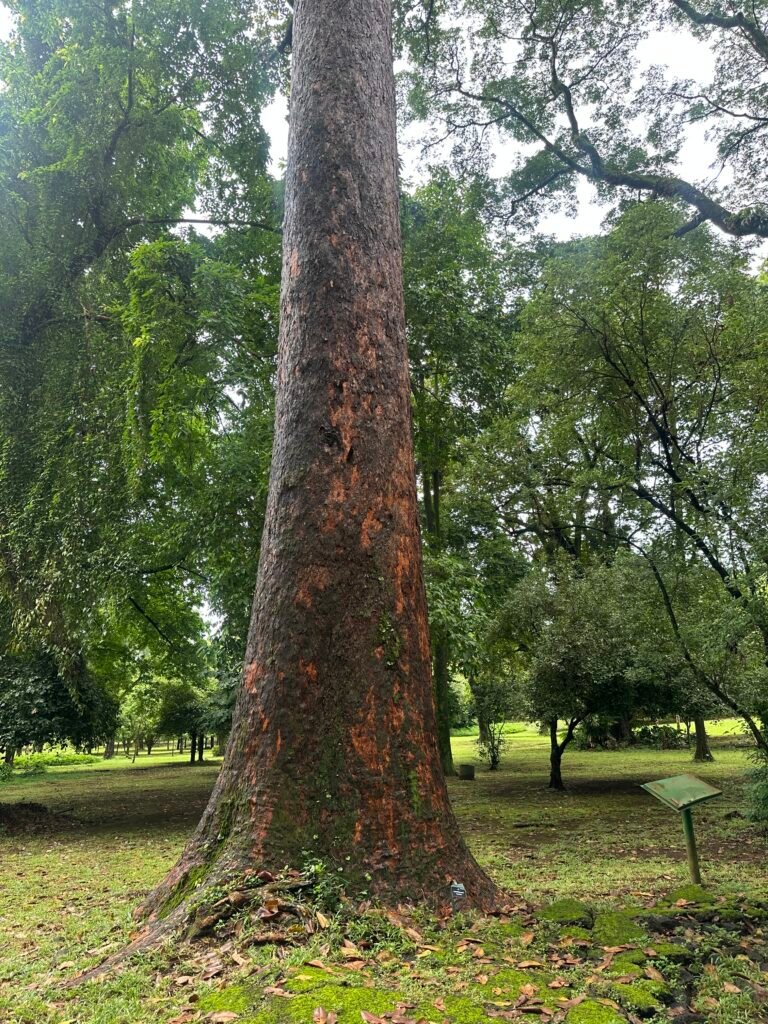
Visually it’s typically red-brown to very dark brown, often with pale mineral deposits in the pores that can give a speckled look on clean faces. That same density is what makes it so hard on tools: cutters dull quickly, pre-boring is essential, and drying needs discipline because checking and end-splitting are common if it’s rushed.
Ekki isn’t a furniture timber—it’s a specification timber. If you see it, it’s usually doing a job where failure is expensive: piling, lock gates, jetties, bridge timbers, heavy decking and high-abuse structural components where you want maximum service life rather than easy workability.
Anatomy
- Porosity: Diffuse-Porous
- Vessel Arrangement: Vessels predominantly in radial multiples; very large, very few. Light-coloured mineral deposits filling vessel cavities are distinctive of Ekki (Lophira alata).
- Vessel Description: Diffuse-porous; vessels predominantly in radial multiples (2–4 vessels per group); solitary vessels rare. Very large pores in no specific arrangement, very few per mm². Light-coloured mineral deposits are a characteristic feature of Ekki.
- Parenchyma: Banded parenchyma (distinctive continuous bands of axial parenchyma) — a key diagnostic feature of Lophira species.
- Rays: Narrow rays, spacing fairly close; rays typically 1–3 cells wide. Ray cells procumbent with some square/upright cells.
Durability
- Durability Class: Class 2 — Durable
Durable. Excellent resistance to decay, marine borers, and insect attack. One of the most durable timbers available for marine and civil engineering.
Odor
No characteristic odor.
Uses & Availability
Common Uses
Marine and freshwater construction (piling, lock gates, groynes, harbour works, jetties), heavy structural use, bridge building, decking in heavy-traffic areas, railway sleepers.
Pricing & Availability
Available in the UK through specialist importers for marine and civil engineering projects. Premium priced due to its extreme density and specialist applications.
Conservation
- CITES Status: Unlisted
- IUCN Status: Vulnerable
Lookalikes & Substitutes
Greenheart is the main alternative for marine work. Opepe and keruing for heavy structural applications.
Working the timber
Very difficult to work with hand tools. Can be worked by machines with less trouble, though blunts cutting edges quickly. Must be pre-bored for nailing. Very difficult to dry — serious checking and end-splitting likely.
Finishing & gluing
Ekki is so dense that many finishes sit “on top” rather than soaking in, which can make adhesion and drying feel slow—thin coats and extended cure times help. The pale mineral deposits in the pores can show through clear finishes as speckling; if you’re aiming for a uniform look, sample first and consider a lightly toned system. Because checking is common, stabilise end grain and seal all faces early in the build, not after final assembly.
Gluing is challenging: the density makes it hard for water-based PVAs to penetrate, and oily/mineral-rich areas can reduce wetting. Freshly machine the joint, de-dust thoroughly, and favour epoxy or resorcinol/phenolic systems designed for dense tropical hardwoods. Clamp firmly and allow longer cure times than you would on lighter species; end-grain joints should be avoided or heavily sized.