
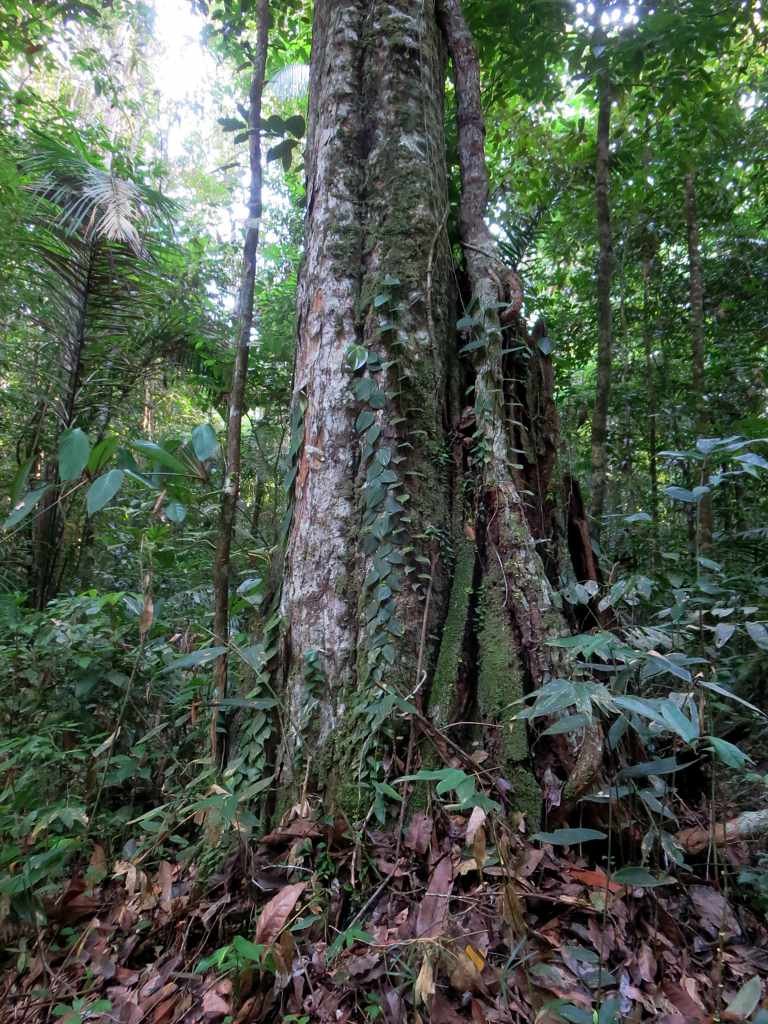
Handling & safety. Splinters from greenheart are notoriously prone to going septic. Dust can cause severe irritation. Contains alkaloids (bebeerine and related compounds) that can cause cardiac effects in rare cases. Handle with care.
Properties
| Latin name | Chlorocardium rodiei |
|---|---|
| Species type | Hardwood |
| Origin | Guyana and Venezuela |
| Density | 1040 kg/m³ |
| Janka hardness | 13,120 N |
| Modulus of rupture | 167 MPa |
| Elastic modulus | 20.4 GPa |
| Crushing strength | 81 MPa |
| Specific gravity | 1.04 |
| Porosity | Diffuse-porous |
| Movement class | Very low |
| Tangential shrinkage | 8.8% |
| Radial shrinkage | 6.7% |
| Volumetric shrinkage | 14.5% |
| T/R ratio | 1.3 |
| Durability (EN 350) | Class 1 |
| Relative cost | Budget |
Density and mechanical properties are typical values at around 12% moisture content. Shrinkage figures represent total dimensional change from fibre saturation to oven dry. Individual boards vary.
Description
Its reputation comes from performance: outstanding resistance to decay, insects and marine borers, plus the kind of mechanical strength needed for harbour works and heavy structures. The wood is hard on tools and doesn’t take nails willingly (pre-boring is standard), but it can still be worked to a smooth, lustrous surface with sharp cutters and patient machining.
Greenheart is rarely chosen for decorative interior woodworking; it’s a specification timber for jetties, lock gates, piling, groynes and other infrastructure that lives wet and gets abused. If a design brief reads “must survive,” greenheart is one of the species engineers reach for first.
Anatomy
- Porosity: Diffuse-Porous
- Vessel Arrangement: Diffuse-porous; vessels small to medium, solitary and in short radial multiples of 2–3, in no specific arrangement.
- Vessel Description: Diffuse-porous; vessels small to medium, solitary and in short radial multiples of 2–3. Perforation plates simple. Intervessel pits are small, alternate.
- Parenchyma: Apotracheal parenchyma diffuse and banded; paratracheal parenchyma vasicentric. Parenchyma strands of 2–4 cells.
- Rays: Rays 1–3 seriate; ray cells procumbent with some upright/square cells mixed. Ray height variable, often relatively low.
Durability
- Durability Class: Class 1 — Very Durable
Very durable (Class 1). Outstanding resistance to marine borers, decay, and insect attack. The benchmark species for marine timber in UK specifications.
Odor
No characteristic odor.
Uses & Availability
Common Uses
Marine piling, lock gates, groynes, jetties, harbour works, bridge construction, chemical vats (due to acid resistance), fishing rods (historically), and heavy structural marine applications.
Pricing & Availability
Available in the UK through specialist marine timber importers. Premium priced. Supply can be irregular.
Conservation
- CITES Status: Unlisted
- IUCN Status: Vulnerable
Lookalikes & Substitutes
Ekki (azobé) is the main alternative for marine work. Opepe for less demanding applications.
Working the timber
Moderately difficult — resists cutting similarly to tough grades of English oak. Dulls cutting edges rather quickly, but a fine, smooth, lustrous surface can be obtained. Cross-grained material must be machined carefully to avoid splintering. Turns easily and finishes well with wax, oil, or polish without filler. Does not take nails well — must be pre-bored. Gluing gives fairly good results. Very low acid content (0.48% acetic acid), so minimal corrosive effect on metal fixings.
Finishing & gluing
Greenheart is so dense and naturally durable that many projects leave it bare, but if you do coat it, expect slower penetration and longer drying—thin coats and extended cure times are your friend. Oils can deepen the olive/yellow tones dramatically and emphasise colour variation within a board; sample first if you’re trying to match pieces. Because the timber is used in wet service, edge and end-grain sealing is critical—water entering checks will undermine any surface film finish quickly.
Gluing is only ‘fair’ compared with lighter hardwoods: the density limits penetration and the surface can burnish, so fresh machining and thorough de-dusting immediately before glue-up is essential. Epoxy is usually the most forgiving choice for greenheart, especially for wet or marine exposure, and it tolerates imperfect surfaces better than PVA. Clamp firmly for contact (pre-bore and dry-fit everything), and avoid relying on end-grain bonds without sizing and reinforcement.