
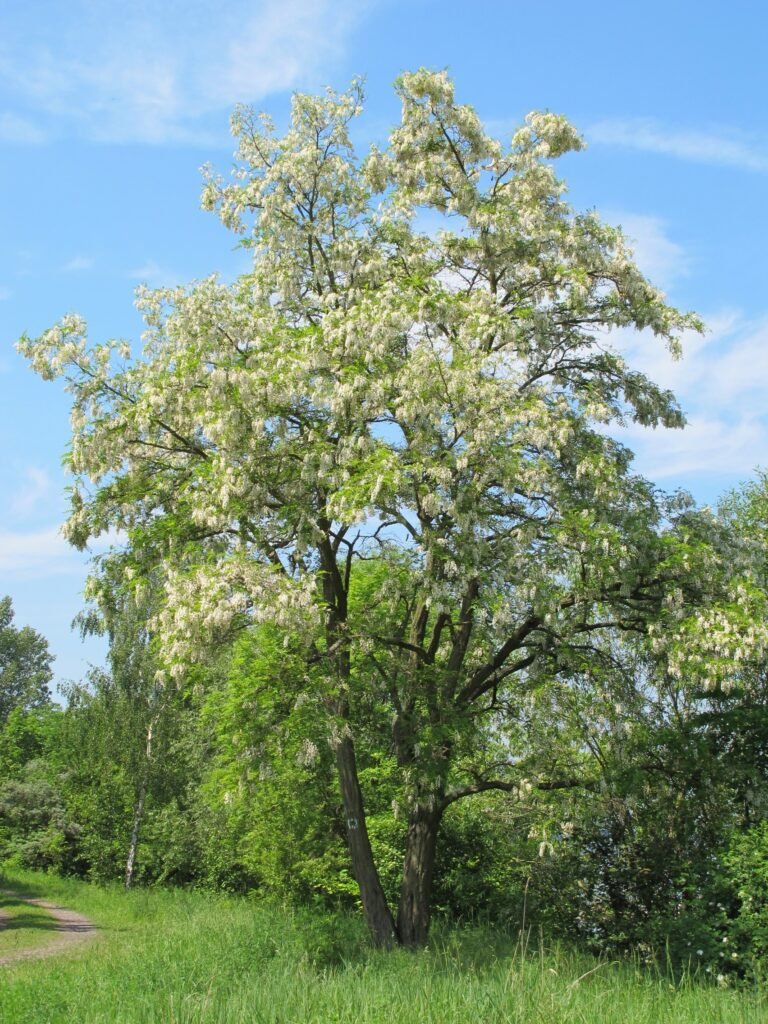
Handling & safety. The bark, leaves, and seeds are toxic if ingested (contain robin, a toxic lectin). The wood itself is not considered toxic for normal woodworking, but dust can cause irritation.
Properties
| Latin name | Robinia pseudoacacia |
|---|---|
| Species type | Hardwood |
| Origin | Native to eastern USA; widely naturalised across Europe including the UK. Major commercial plantations in Hungary and other Central European countries |
| Density | 770 kg/m³ |
| Janka hardness | 7,560 N |
| Modulus of rupture | 134 MPa |
| Elastic modulus | 14.1 GPa |
| Crushing strength | 70.3 MPa |
| Specific gravity | 0.77 |
| Porosity | Ring-porous |
| Movement class | Very low |
| Tangential shrinkage | 7.2% |
| Radial shrinkage | 4.4% |
| Volumetric shrinkage | 10.2% |
| T/R ratio | 1.6 |
| Durability (EN 350) | Class 2 |
| Relative cost | Budget |
Density and mechanical properties are typical values at around 12% moisture content. Shrinkage figures represent total dimensional change from fibre saturation to oven dry. Individual boards vary.
Description
That durability is the headline: robinina can outperform many treated softwoods and even some tropical species without any chemical treatment, which is why it’s increasingly specified for posts, decking, outdoor furniture and structural exterior work. The trade-off is workability—sharp tooling and pre-boring aren’t optional if you want clean joinery.
Robinia is also highly tannin/acid rich, so fixings matter (stainless is the safe default). Treated with the respect you’d give a dense tropical hardwood, it rewards you with long service life outdoors and a tough, crisp feel in finished components.
Anatomy
- Porosity: Ring-Porous
- Vessel Arrangement: Ring-porous. Earlywood: large pores in a continuous band, typically 1–3 rows. Latewood: small to very small pores, solitary or in short radial multiples of 2–3. Tyloses common in heartwood, giving Robinia excellent durability.
- Vessel Description: Ring-porous; earlywood pores large and in a continuous band (1–3 rows), latewood pores small to very small, solitary or in short radial multiples of 2–3. Tyloses common in heartwood.
- Parenchyma: Apotracheal parenchyma diffuse; also paratracheal (vasicentric) parenchyma sheathing vessels.
- Rays: Uniseriate and multiseriate; rays narrow, commonly 1–3 cells wide; ray cells predominantly procumbent.
Durability
- Durability Class: Class 2 — Durable
Very durable to durable (Class 1–2 per BS EN 350). Outstanding natural resistance to decay, insects, and fungal attack without any chemical treatment. Predicted 40+ years in ground contact, 100+ years above ground.
Odor
Faint, pleasant scent when freshly cut.
Uses & Availability
Common Uses
Outdoor furniture, playground equipment, fencing (agricultural and garden), decking, raised beds, retaining walls, vineyard posts, boat building, and structural outdoor timber. Increasingly specified in the UK as a chemical-free alternative to pressure-treated softwood.
Pricing & Availability
Increasingly available in the UK, primarily imported from Hungary and Central Europe. Moderately priced for a durable hardwood. Growing in popularity as a sustainable alternative to tropical hardwoods for outdoor applications.
Conservation
- CITES Status: Unlisted
- IUCN Status: Least Concern
Lookalikes & Substitutes
Competes with oak, sweet chestnut, and treated softwoods for outdoor applications. Offers superior durability to most European hardwoods without treatment. Teak and iroko are tropical alternatives.
Working the timber
Moderately difficult due to high density and hardness. Can dull cutting tools quickly. However, sands and finishes well, takes stains and finishes evenly. Pre-boring recommended for fixings. Contains highly acidic tannins which can corrode ferrous metals — use stainless steel fixings.
Finishing & gluing
Robinia’s naturally durable, tannin-rich heartwood can be left bare outdoors, where it weathers quickly to a grey—if you want to hold colour, use a UV-resistant exterior oil and expect regular re-coats. The dense, hard surface can burnish under sanding, which reduces finish penetration; a final sharp scrape or a light scuff with fresh abrasive gives better wetting. Because the tannins are highly acidic, test water-based finishes first—some systems can shift colour or raise grain more aggressively than on milder species.
Robinia’s density and extractives make it less forgiving than ‘easy’ hardwoods: freshly machine the joint faces, de-dust thoroughly, and glue immediately rather than letting surfaces oxidise. Epoxy and PU tend to be more reliable than standard PVA for robinina, especially for exterior work, and they tolerate slight gaps when the timber moves. Use moderate clamp pressure and pre-bore for any mechanical reinforcement—splitting near fixings can open glue lines.