
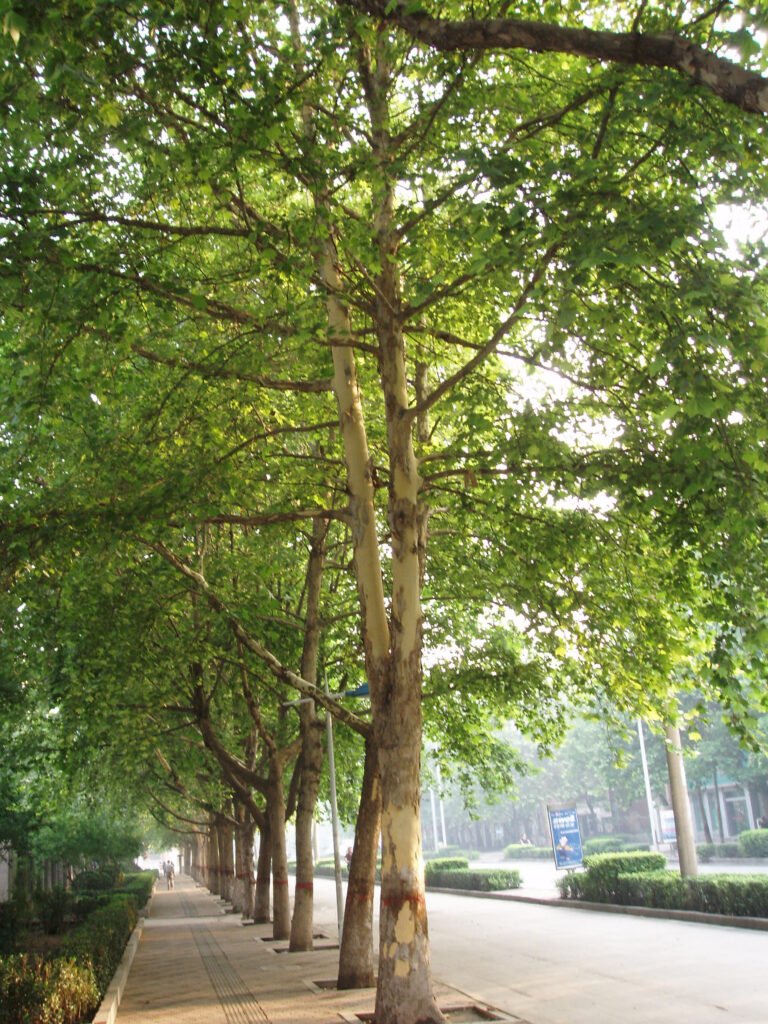
Handling & safety. No specific reactions noted beyond general wood dust risks (Wood Database notes sycamore/plane).
Properties
| Latin name | Platanus × acerifolia |
|---|---|
| Species type | Hardwood |
| Origin | Widely planted across the UK and Europe (hybrid origin); common urban tree. |
| Density | 560 kg/m³ |
| Janka hardness | 4,180 N |
| Modulus of rupture | 74.7 MPa |
| Elastic modulus | 8.9 GPa |
| Crushing strength | 40.8 MPa |
| Specific gravity | 0.56 |
| Porosity | Diffuse-porous |
| Movement class | Very low |
| Tangential shrinkage | 10% |
| Radial shrinkage | 6% |
| Volumetric shrinkage | 16% |
| T/R ratio | 1.7 |
| Durability (EN 350) | Class 5 |
| Relative cost | Budget |
Density and mechanical properties are typical values at around 12% moisture content. Shrinkage figures represent total dimensional change from fibre saturation to oven dry. Individual boards vary.
Description
Anatomy
- Porosity: Diffuse-Porous
- Vessel Arrangement: Solitary, radial multiples, and clusters
- Vessel Description: Small to medium pores, numerous; tyloses occasionally present
- Parenchyma: Rare or absent.
- Rays: Medium to very wide; easily visible without lens; noded; wide spacing.
Durability
- Durability Class: Class 5 — Perishable
Non-durable to perishable regarding decay resistance; susceptible to insect attack.
Odor
No characteristic odor.
Uses & Availability
Common Uses
Veneer, plywood, interior trim, pallets/crates, flooring, furniture, carvings, small specialty items.
Pricing & Availability
Usually moderately priced if domestically available; quartersawn boards can cost more.
Conservation
- CITES Status: Unlisted
Lookalikes & Substitutes
Not to be confused with ‘European sycamore’ (which is actually a maple: Acer pseudoplatanus). London plane (Platanus × acerifolia) is closely related to American sycamore (Platanus occidentalis) and Oriental plane (Platanus orientalis), and their wood is broadly similar; quartersawn material is sometimes sold as ‘lacewood’ due to prominent ray fleck.
Working the timber
Works easily; tearout can occur in rays in perfectly quartersawn material; turns, glues, and finishes well.
Finishing & gluing
Turns, glues, and finishes well; tearout can occur on perfectly quartersawn ray areas, so use sharp cutters and light passes.
Glues well with standard woodworking adhesives; use normal surface prep and clamp pressure.