
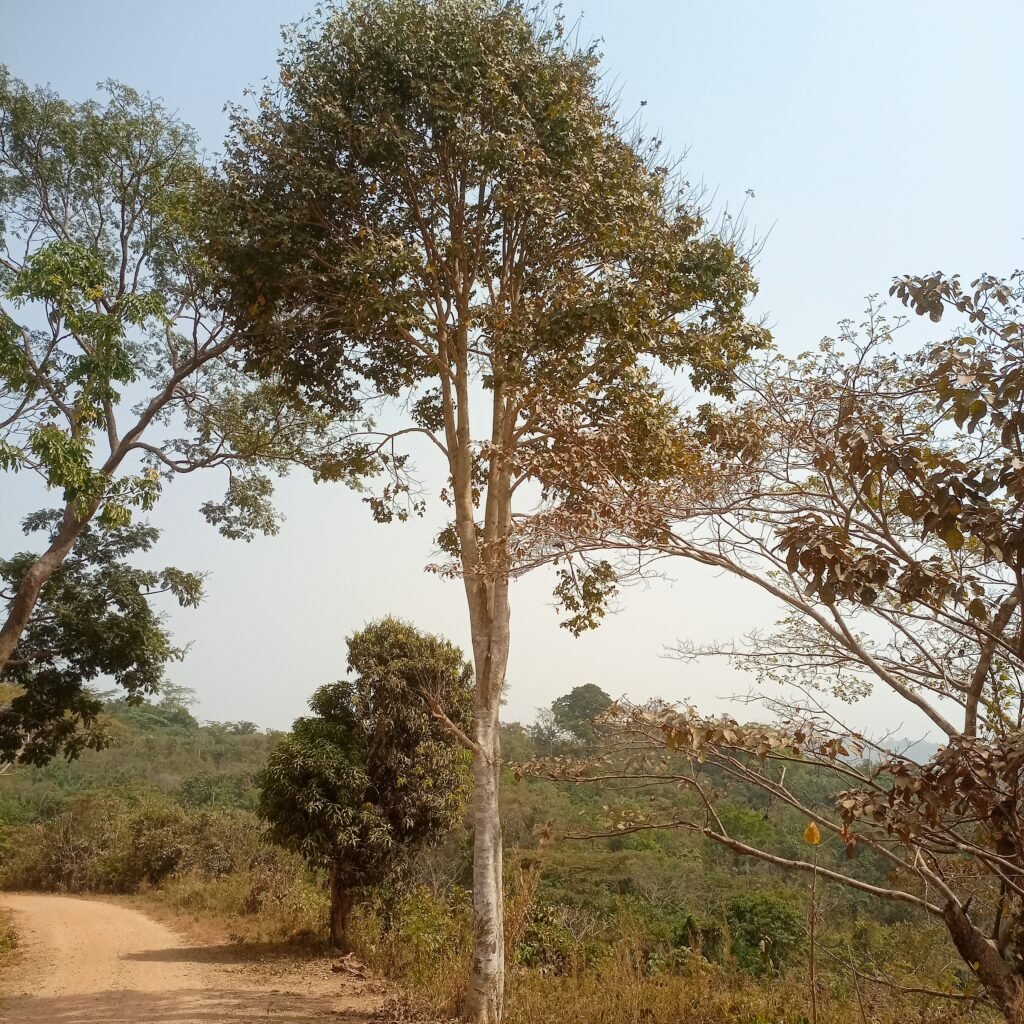
Handling & safety. Reported as a sensitiser. Dust can irritate eyes, skin and airways. Extract when machining.
Suitable uses
Interior joinery, mouldings, model-making, and as the base timber for ThermoWood Ayous cladding.
Browse projectsProperties
| Latin name | Triplochiton scleroxylon |
|---|---|
| Species type | Hardwood |
| Origin | Tropical West Africa. |
| Density | 380 kg/m³ |
| Janka hardness | 1,960 N |
| Modulus of rupture | 59.8 MPa |
| Elastic modulus | 6.44 GPa |
| Crushing strength | 29.7 MPa |
| Specific gravity | 0.38 |
| Porosity | Diffuse-porous |
| Movement class | Very low |
| Tangential shrinkage | 5.3% |
| Radial shrinkage | 3.1% |
| Volumetric shrinkage | 8.7% |
| T/R ratio | 1.7 |
| Durability (EN 350) | Class 5 |
| Relative cost | Budget |
Density and mechanical properties are typical values at around 12% moisture content. Shrinkage figures represent total dimensional change from fibre saturation to oven dry. Individual boards vary.
Ayous (Obeche) — the light, stable, paintable hardwood
Ayous is the lightest hardwood most people will ever work with, and that single fact explains almost everything about it. It’s a pale, creamy-white timber — almost no colour to it at all — and it’s soft enough to mark easily, which is why it never turns up as a finish timber. What it does instead is the jobs where you want something flat, stable, easy to cut and cheap to buy, and which is going to be painted or covered up anyway.
The name catches people out. The same timber is sold as ayous, obeche, samba and wawa depending on who’s selling it and where it came from. In Britain the trade name has traditionally been obeche; in much of mainland Europe and West Africa it’s ayous. They’re the same species — Triplochiton scleroxylon — and if a supplier sends one and delivers the other, nothing has gone wrong.
What it’s like to work
Genuinely easy, in almost every respect. It cuts, sands, carves and shapes without fighting you, glues well, and takes paint superbly — which is the point of it. There’s interlocked grain in some stock that can tear out a little during machining, and its softness means you can leave dents if you’re careless with cramps or handling. It’s a timber that wants sharp tooling, because blunt edges crush it rather than cut it. One oddity worth expecting: green ayous has a strongly unpleasant smell, which mostly disappears once it’s dried.
Where it earns its place
Painted joinery and mouldings, where a stable pale timber that takes paint is exactly what you want and its colour is irrelevant. Model-making and pattern-making, where its lightness and workability are ideal. Veneer backing and drawer boxes, where it’s hidden. Interior signage.
The ThermoWood connection
Ayous is one of the hardwoods sold thermally modified — heated to around 200°C in a low-oxygen kiln until its chemistry changes. (Most ThermoWood is Scots pine or spruce; ayous is a common hardwood option.) The heat breaks down the sugars that decay fungi feed on, which turns a timber with no natural durability into one that can live outside. The result is a darker, more stable board suitable for cladding and decking without chemical preservatives.
That’s a real product with real advantages — but the honesty point is this: it’s the process doing the work, not the species. Bare ayous left outside would be firewood inside a couple of seasons. If you’re buying ThermoWood ayous for an exterior job, you’re buying the treatment.
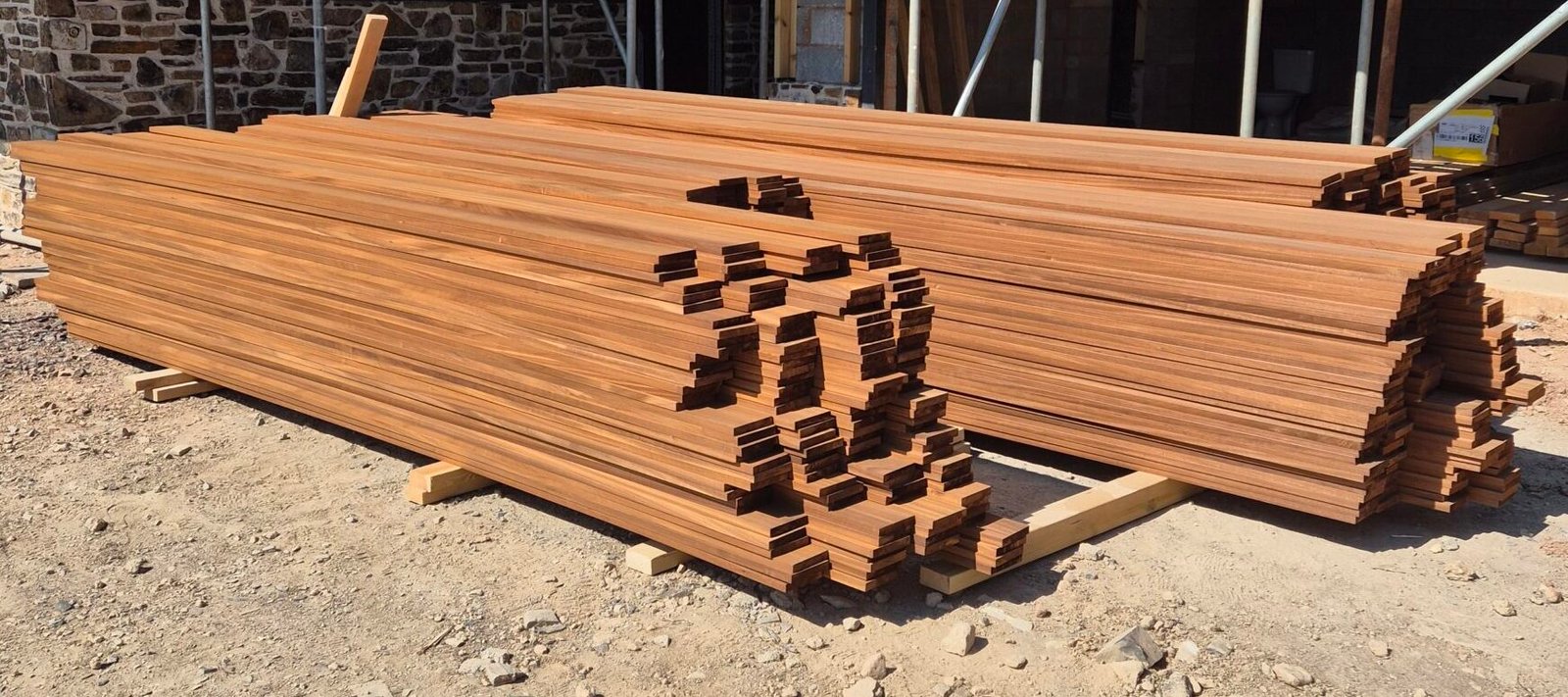
Thermo Ayous is much darker than raw Ayous. Here is an example:
Where it costs you
Almost nothing in money — it’s one of the cheapest hardwoods available. What it costs you is care: it dents, it crushes, and it won’t stand up to heavy use or any exposure. Treat it as a light, stable, paintable timber and it does a very good job; expect a heavy-duty timber and you’ll be disappointed.
Working the timber
Generally easy to work. Interlocked grain can tear in places. It carves, stains and finishes well. Typical figures from The Wood Database for obeche (ayous).
Finishing & gluing
Pale and even, so it takes paint and stain as a blank rather than a show timber.
Glues well on a fresh, dust-free face.