Cladding is the use where getting the species right matters least, and getting everything around it right matters most. Cedar, larch and thermowood will all clad a wall and look good doing it. The differences that ruin jobs are profile, ventilation and how much room the boards have to move.
Here’s how the choices break down.
Timber choices for cladding
Three timbers do most of the work. They’re genuinely different, and the right one depends on what you care about most.
| Timber | What to know |
|---|---|
| Western Red Cedar | Stable, low movement and durable in the heartwood, and it needs no finish to perform. Imported Canadian cedar is rated durable; UK-grown cedar is usually knottier and rated lower, so check which you’re getting. This is the choice when the priority is a cladding that behaves itself and you can leave to silver down. It’s the most forgiving of the three and usually the most expensive. It’s also soft, so it dents and marks where it can be knocked. |
| Larch | The value exterior softwood, and often the UK-grown option. The heartwood is moderately durable and harder than cedar, but larch is more prone to distortion and surface checking, so fixing and detailing matter more. Cheaper than cedar and a well-proven choice for cladding, as long as it’s fixed properly and the boards are heartwood with the sapwood kept out. |
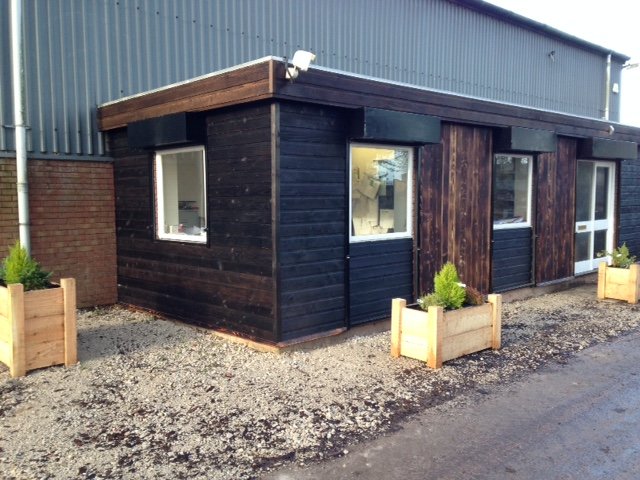
| Thermowood | Heat-treated softwood, usually pine or spruce. Manufacturers quote swelling and shrinkage at about half that of untreated pine, which makes it the calmest of the three, and rate it durable for above-ground use. It comes out of the kiln an even brown and takes a pigmented stain consistently, which is why it’s the usual pick for a dark or consistent façade. Left uncoated, it weathers to silver-grey like the other two. |
There’s no wrong answer here, only a right answer for the look and the budget. Which leads to the distinction that actually decides the job:
Cedar, larch or thermowood?
Cedar if you want stability and no finish. Of the untreated timbers it moves least and needs least, and it weathers to a soft silver that most people are happy to leave alone. The cedar page covers the Canadian and UK-grown differences.
Larch if you want the UK-grown option and a better price. You’re trading some stability for value, and you take on the responsibility of fixing it well, because larch will show you if you haven’t. Fixed over a ventilated cavity with room to move, it gives a long service life. It’s also worth reading the larch page’s supply notes before specifying, because Siberian larch is now hard to get (the UK has banned imports of Russian wood since 2022), so European larch is the usual choice.
Thermowood if you want dark and low-movement. The heat treatment roughly halves swelling and shrinkage, and the boards take a finish consistently, which is why it suits modern dark façades and stained schemes across a large elevation. Holding that colour needs a pigmented stain that you maintain; uncoated, it goes grey. Screws also hold less well in heat-treated timber, so predrill. The thermowood page has more.
Practical notes
Profiles you’ll be asked about
- Shiplap: the lower edge of each board laps over a rebate in the top of the board below. Neat, traditional, forgiving of slight movement.
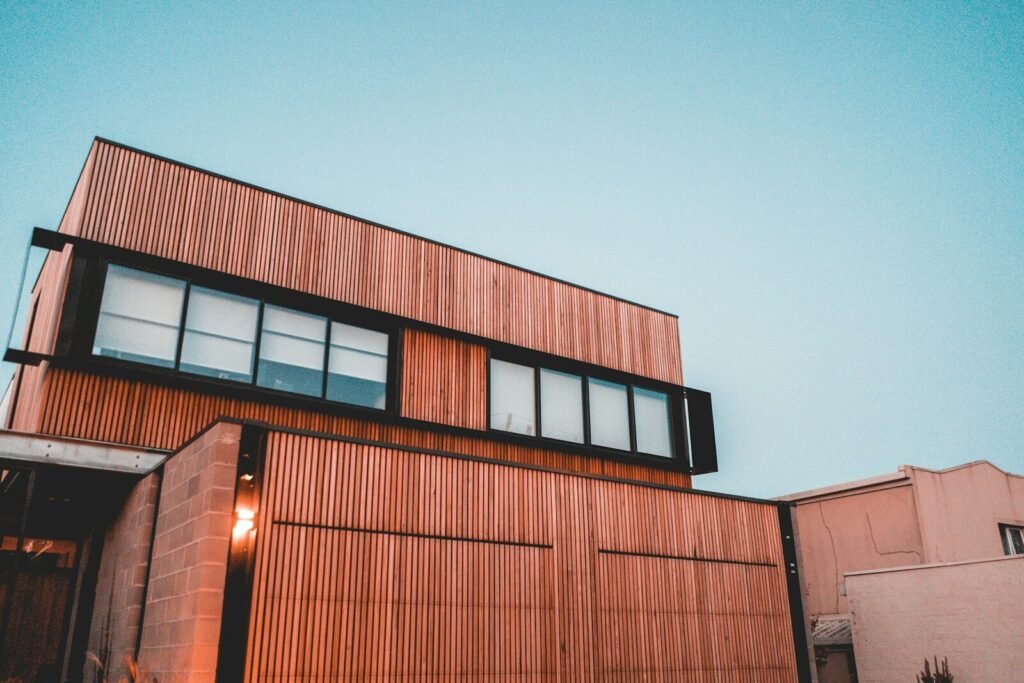
- Tongue and groove: flat face, boards locked edge to edge, and the usual choice for a crisp contemporary look. Fit horizontal boards tongue upwards, keep the face width to around 125mm, and leave a little clearance at the tongue so the boards can swell without the face bowing.
- Feather edge: tapered boards, fixed horizontally so each one overlaps the board below by at least 15mm. Rustic, and it sheds water well. Fixed vertically, feather edge is the familiar fencing board.
The profile matters more than people expect: a flat face shows movement in the boards more plainly, where an overlapped profile hides some of it. If you’re set on a flat profile in a timber that moves, that’s a decision worth making knowingly.
Movement and ventilation
Cladding moves. It moves across the grain as it takes up and loses moisture, swelling in wet weather and shrinking in dry. Every board wants a drained, ventilated cavity behind it (at least 19mm, usually the depth of the battens, open at the bottom and the top) and room to swell and shrink without being pinned. Cladding fixed tight to a solid wall can’t dry out, and boards fixed so they can’t move will cup and split. The timber usually gets the blame.
Fixing
- Use stainless steel fixings. Annular ring-shank nails are the usual choice for softwood boards. Plain and galvanised steel can corrode and stain, and tannin-rich or acidic timbers (oak, sweet chestnut, western red cedar) speed that up and react with the iron to leave dark marks. Streaks down a clad wall are almost always the fixing, not the timber.
- Don’t fix too close to the ends. Near a board end there isn’t enough material either side of a nail or screw, and it will split. Predrill and keep back from the ends.
- Leave the gaps, and don’t pin boards together. On horizontal boards that’s about 2mm at each overlap or above each tongue, and 8 to 10mm where boards meet a corner. On overlapping profiles, place the fixing so it misses the board below, or the two boards are nailed together and can’t move.
Weathering and finishing
Untreated exterior timber weathers: under UV light the surface colour fades to silver-grey, or grey-brown in some species and dirtier locations. This is a surface change, not decay, and plenty of cladding is meant to be left that way. If you want to hold a colour, a pigmented stain slows the change but needs reapplying. Decide which you want before you fix it, because you can’t easily change your mind later.
Work out how much you need before you buy
Cladding quantities catch people out because board width isn’t coverage. Profiles overlap, so the coverage is narrower than the nominal board. Work out the area, then the board count with an allowance for wastage, and you won’t be short mid-elevation. The cladding calculator does that for you.
Sources
- TRADA, External wood cladding (Choose and Use sheet) (19mm ventilated cavity, gaps at overlaps and corners, tongue upwards and 125mm face width, 15mm feather edge overlap, stainless ring-shank nails, sapwood exclusion, silvering)
- GreenSpec, Timber cladding: selecting a species (EN 350 durability and movement for cedar, larch, oak and sweet chestnut; fixings for cedar, oak and chestnut)
- Scottish Government, Timber cladding in Scotland (cedar is soft and easily damaged, UK-grown cedar is knottier, cedar costs more, drained and back-ventilated cavities)
- Metsä Wood, ThermoWood exterior cladding technical data (swelling and shrinkage about 50% of untreated pine, durability class 2, greys under UV, pigmented stain, lower screw holding, stainless nails)
- Thermory, Thermo-pine cladding datasheet (durability class 2 to EN 350, weathers to grey unless coated)