
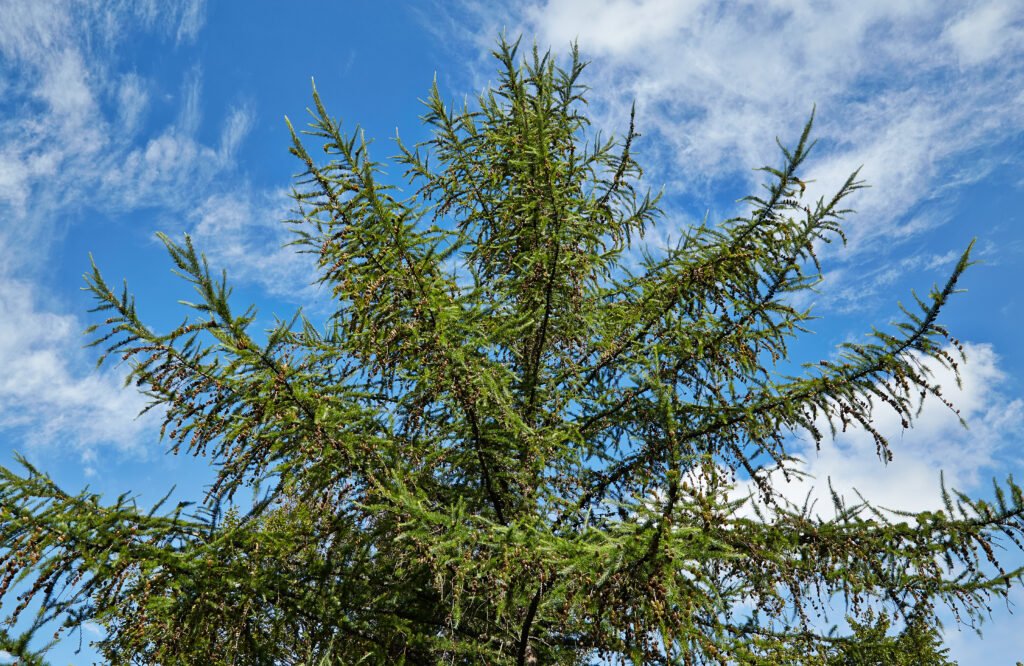
Handling & safety. No significant health reactions reported beyond standard wood dust risks.
Properties
| Latin name | Larix × marschlinsii |
|---|---|
| Species type | Softwood |
| Origin | Planted throughout UK, Ireland, and northern Europe (hybrid origin — cross of European and Japanese Larch) |
| Density | 530 kg/m³ |
| Janka hardness | 3,250 N |
| Modulus of rupture | 80 MPa |
| Elastic modulus | 10.2 GPa |
| Crushing strength | 44 MPa |
| Specific gravity | 0.53 |
| Porosity | Non-porous (softwood) |
| Movement class | Very low |
| Tangential shrinkage | 7.2% |
| Radial shrinkage | 4.3% |
| Volumetric shrinkage | 11.8% |
| T/R ratio | 1.7 |
| Durability (EN 350) | Class 4 |
| Relative cost | Budget |
Density and mechanical properties are typical values at around 12% moisture content. Shrinkage figures represent total dimensional change from fibre saturation to oven dry. Individual boards vary.
Description
In use it behaves like a tougher, more exterior-minded softwood than spruce or many pines: decent natural durability above ground, good stiffness, and strong fixing performance. It machines well, though resinous knots can be hard on cutters, and pre-drilling near edges is wise to prevent splits.
Hybrid larch turns up in fencing, cladding, garden structures and general outdoor construction where you want a locally available, robust softwood that can weather a bit of punishment. In the UK trade it’s also often sold simply as “larch,” alongside European and Japanese material, because the working and performance envelope is broadly similar.
Anatomy
- Porosity: Non-porous
- Vessel Arrangement: Tracheids present; resin canals small to medium, numerous and evenly distributed, mostly solitary; earlywood to latewood transition fairly abrupt.
- Vessel Description: N/A — softwood. No vessels; water conduction via tracheids.
- Parenchyma: Axial parenchyma in discontinuous uniseriate strands of 2–4 cells.
- Rays: Uniseriate; ray cells procumbent; typically 1–8 cells high.
Durability
- Durability Class: Class 4 — Slightly Durable
Moderately durable heartwood. Performance is broadly similar to the parent species.
Odor
Resinous scent when freshly cut.
Uses & Availability
Common Uses
Fencing, cladding, garden structures, estate work, boat planking, outdoor construction, and increasingly for cross-laminated timber (CLT) trials.
Pricing & Availability
Widely available in the UK from domestic forestry. Inexpensive — often sold interchangeably with European or Japanese Larch.
Conservation
- CITES Status: Unlisted
- IUCN Status: Not Evaluated
Lookalikes & Substitutes
European Larch and Japanese Larch — all three are often sold together simply as ‘larch’ in the UK trade.
Working the timber
Easy to work with hand and machine tools. Resinous knots can dull cutters. Glues and finishes well.
Finishing & gluing
Hybrid (Dunkeld) larch carries the same larch signature: resinous knots and strong growth-ring contrast, so colour work can go uneven unless you seal first. When clear-finishing, keep sanding flat and even—soft earlywood dishes out and leaves ridges that telegraph under varnish. For exterior paint, isolate knots and seal end grain early to reduce resin bleed and coating failure around checks.
Larch usually bonds well, but resin pockets can cause local glue failure—scrape back glossy pitch and glue soon after machining. PVAs and PU work for most joinery; for exterior, PU or epoxy is a safer bet where joints may see moisture cycling. Pre-drilling near edges helps prevent splits that can open glue lines over time.