
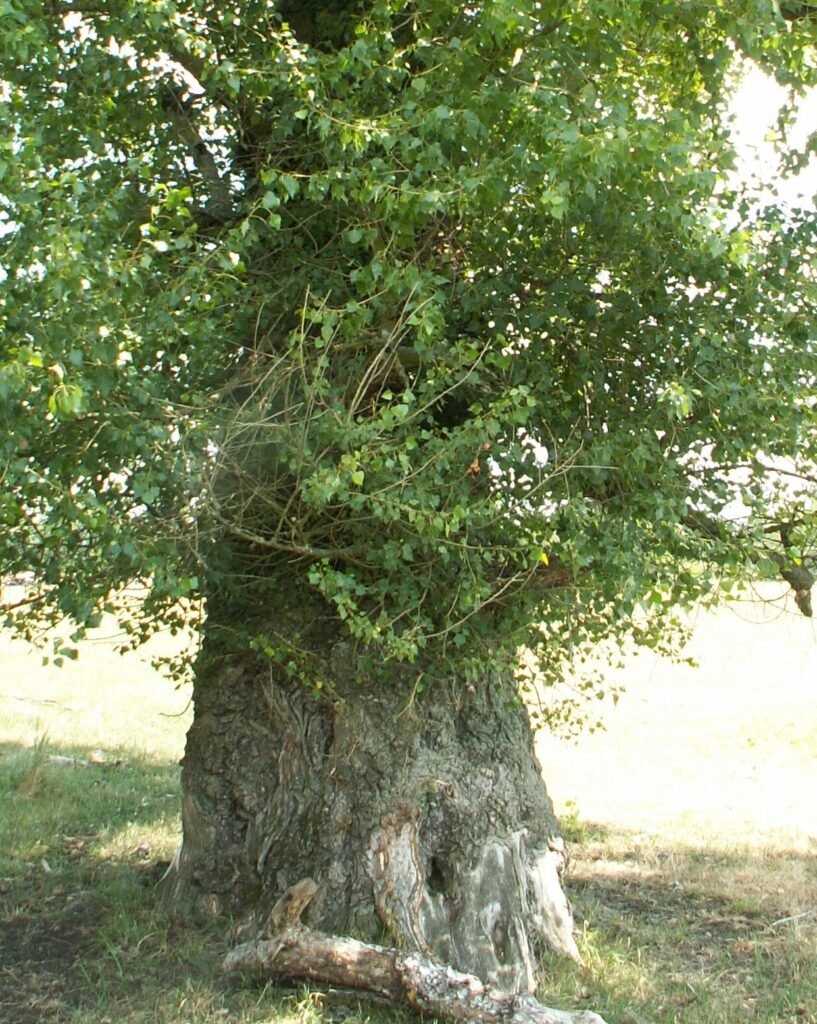
Handling & safety. No specific reactions noted beyond general wood dust risks.
Suitable uses
Furniture carcasses and concealed components, drawer sides, lightweight interior joinery, plywood and veneer, boxes and crates, carving, turning, toys, pattern-making and painted work.
Browse projectsProperties
| Latin name | Populus nigra |
|---|---|
| Species type | Hardwood |
| Origin | Europe, western Asia, Northern Africa; planted elsewhere as ornamental. |
| Density | 385 kg/m³ |
| Janka hardness | 2,020 N |
| Modulus of rupture | 63.7 MPa |
| Elastic modulus | 7.21 GPa |
| Crushing strength | 36 MPa |
| Specific gravity | 0.39 |
| Porosity | Diffuse-porous |
| Movement class | Very low |
| Tangential shrinkage | 9.3% |
| Radial shrinkage | 4% |
| Volumetric shrinkage | 12.3% |
| T/R ratio | 3.3 |
| Durability (EN 350) | Class 5 |
| Relative cost | Budget |
Density and mechanical properties are typical values at around 12% moisture content. Shrinkage figures represent total dimensional change from fibre saturation to oven dry. Individual boards vary.
It is not a naturally durable timber, so it is best suited to internal, dry or protected uses unless treated or carefully detailed. Black poplar is commonly associated with crates, boxes, pallets, light construction, plywood, utility joinery, carving, turning, drawer sides and painted work. It can also be useful for rustic, low-stress craft projects where a pale, lightweight timber is wanted and high wear resistance is not essential.
For makers, black poplar’s main appeal is that it is light, forgiving and relatively easy to machine, cut, nail and glue. It is not the best choice for exposed outdoor work, heavy-duty furniture, flooring or anything requiring high strength and hardness, but it can be a sensible material for simple interior projects, painted pieces, lightweight components and experimental work. In a species library, it is best presented as a practical utility hardwood rather than a premium decorative timber.
Working the timber
Easy to work; sharp cutters needed to avoid fuzzy planed surfaces; fine sanding may be required; can warp/distort during drying; glues and finishes well.
Finishing & gluing
Black poplar can be finished successfully, but it is not a naturally decorative timber and can sometimes look a little plain or uneven under clear finishes. It is often better suited to paint, stain, dye, wax or simple interior clear coats than high-end transparent finishing. Because it is soft and absorbent, test stains and dyes first, as colour can take unevenly or look blotchy without a sanding sealer or pre-stain conditioner. Sand carefully and avoid over-sanding soft areas, as the surface can become slightly woolly or compressed.
Black poplar generally glues well with standard woodworking adhesives, including PVA, aliphatic resin, polyurethane and epoxy. Its relatively soft, porous structure gives good bonding surfaces, but joints should be clean, freshly prepared and not crushed by excessive clamping pressure. Because the timber is light and soft, use enough pressure to close the joint without squeezing out too much glue or deforming the fibres. For exterior or damp use, only use an exterior-rated adhesive, though the timber itself is not naturally durable unless protected or treated.